End of Line Testing: Your Final Defense Against Defects
What EOL tests check, why good products fail and bad ones pass, and how test data helps find the root cause.


- EOL testing is the last check before a product ships. Catching a defect here costs far less than a return, a warranty claim, or a recall.
- Set limits from the specification, how much you can trust the measurement, and which wrong call costs more. Guard bands help when readings land close to a limit.
- Check every station with a known-good master part and known-defective challenge parts, as often as your control plan requires and after every fixture repair or changeover.
- Record every test attempt, set a retry limit before someone investigates, and send reworked units through the required tests again.
- Keep measurements, recipe versions, and retest history against each serial number, so you can tell a product problem from a station problem.
End of line (EOL) testing is the last check a product gets before it's boxed up and shipped. The station runs it through a fixed set of electrical, mechanical, or functional tests, compares each result with its limit, and says pass or fail.
It sounds simple, and most of the time it is. The trouble is that a station can get the answer wrong for weeks without anyone noticing. A worn contact pin starts rejecting good units, and people blame a bad batch. Someone mistypes a limit during a changeover, and defective units go straight out the door. The screen still just says PASS or FAIL, which is why these problems last so long.
This post covers how EOL stations work, but mostly the part people skip: setting limits you can defend, checking that the station is telling the truth, and using test data to catch problems early.
What End of Line Testing Checks
There isn't one standard EOL test. What you check depends on the product and how it tends to fail. Most test plans pull from four groups:
- Electrical: Voltage, current, continuity, and insulation resistance.
- Mechanical: Torque, pressure, movement, and leak rates.
- Functional: Does the product actually do the job it was built for?
- Communication and software: Does it talk to other systems properly, and is it running the right firmware and configuration?
What makes EOL testing worth having is that it tests the finished product. Every part can pass inspection and the assembly can still fail because a connector went on the wrong way or the configuration is wrong. Those manufacturing defects don't exist until the product is put together, so the end of the line is the first place you can catch them.
How End of Line Testing Works
Whatever the product, the flow at the station is roughly the same.
1. Identify the unit. A scanner reads the barcode, serial number, or VIN, and the station loads the right test recipe for that variant. With a manufacturing execution system (MES), the station can also confirm the unit finished every earlier step, so a half-repaired unit never reaches the tester.
2. Run the tests. A PLC or test computer clamps the part, powers it up, steps through each check, and compares every reading with its limit.
3. Decide and record. Passing units go to packing; failing units go to rework or investigation. Either way, the result is saved against the serial number. Nothing should ship without a passing EOL record.
Test order matters. Run continuity and insulation checks before powering anything up, so a short circuit shows up before it damages the product or the station. Then put quick checks for your most common faults ahead of long performance tests, so a bad unit gets rejected in seconds. All of it has to fit inside the line's takt time, and loading and connecting the product often takes longer than the measurements themselves.
Setting Test Limits
A pass/fail decision is only as good as the limit behind it. Setting one means balancing three things: what the specification allows, how much you trust the measurement, and what it costs to be wrong in either direction.
No measurement is perfect, so a reading right on the limit could belong on either side. Guard bands handle this by pulling the acceptance limits slightly inside the specification limits. How far depends on how noisy the measurement is and which mistake hurts more: shipping a bad unit or scrapping a good one.
If you don't know how far to trust a measurement, run a Gage Repeatability and Reproducibility (Gage R&R) study first. The AIAG Measurement Systems Analysis (MSA) reference covers the method, and NIST explains how uncertainty drives both kinds of wrong decision.
Revisit limits after a few weeks of production. If readings cluster near a limit, check whether the process is drifting or the limit is too tight. If defects are escaping, the limit may be too loose. Check any change against the specification before it goes live.
Verifying the Test Station
Calibration tells you an instrument reads correctly against a standard. It doesn't tell you the whole setup works. A freshly calibrated leak tester still gives bad readings if its seal is worn.
So check the station as a whole, with a known-good master part and a few known-defective challenge parts. The master should pass, and each challenge part should fail at the exact step meant to catch its defect. Include challenge parts that are only just outside the limit, because marginal defects are the ones that slip through. Run these checks as often as your control plan and customers require, and always after a fixture repair or changeover.
If a challenge part passes when it shouldn't, every result since the last good check is in doubt. Hold those units until you know what happened. Look after the challenge parts too: label them, store them properly, and check them periodically, because a defect that changes over time stops being a useful test.
Common Causes of Test Failures
When units start failing and nobody knows why, the cause is nearly always in one of three places.
The product. Something was assembled wrong, a part was damaged, or a component was out of spec. These failures tend to pile up on the same test step, which points upstream to the process or the component lot.
The test equipment or environment. Sensor drift, worn fixtures, bad contacts, and temperature swings all cause false results. Leak tests are especially sensitive: a part warmer or colder than the test air shifts the pressure reading on its own.
The test configuration. An old recipe, a wrong limit, or a software change nobody validated.
When several units fail the same way, contain the affected product with your containment action procedure.
Retests need rules. Record every attempt, including the first failure, and set how many retries a unit gets before someone investigates. Otherwise an intermittent connection can fail once, pass on retest, and ship unfixed. A rising retest rate often points to fixture wear or bad contacts, but confirm it against the failure modes and maintenance records before blaming the station.
For hipot tests, follow the equipment manufacturer's retest instructions, because repeated full-voltage tests stress the insulation. After any rework, run the required tests again.
What Your Test Data Is Telling You
Pass/fail tells you whether a unit made it. The measured value tells you whether it made it easily or only just, which is usually more useful. Keep the measurements with their limits, serial numbers, recipe versions, timestamps, and retest history. That record lets you separate product, process, and station problems, and it gives you traceability when a component lot turns out to be bad.
Track four numbers:
- First-pass yield: Units that pass every test on their first attempt, divided by all units tested.
- Retest rate: Units that needed at least one more attempt, divided by all units tested.
- Failures by test step: Which checks reject the most units.
- Escape rate: How often defects reach customers even though they passed EOL testing.
First-pass yield matters most, because final acceptance hides retests. If 900 of 1,000 units pass first time and 90 of the rest pass after retest or rework, final acceptance is 99% but first-pass yield is 90%. The 99% alone would never tell you that one unit in ten failed its first attempt. Track both: first-pass yield shows how well you're building, and final acceptance shows what you're shipping.
Trends warn you before anything fails. If a motor's current draw creeps up every week while every unit still passes, something is adding mechanical resistance. When a defect does escape, ask whether the test covered that failure mode, and if so, whether its limits could catch it. Root cause analysis shows where the fix belongs.

Connecting EOL Stations With FlowFuse
In most plants, EOL measurements sit in station logs while PLC data, production records, and maintenance history live elsewhere. Answering "why is this station failing more units this week?" means exporting spreadsheets from three systems and lining them up by hand.
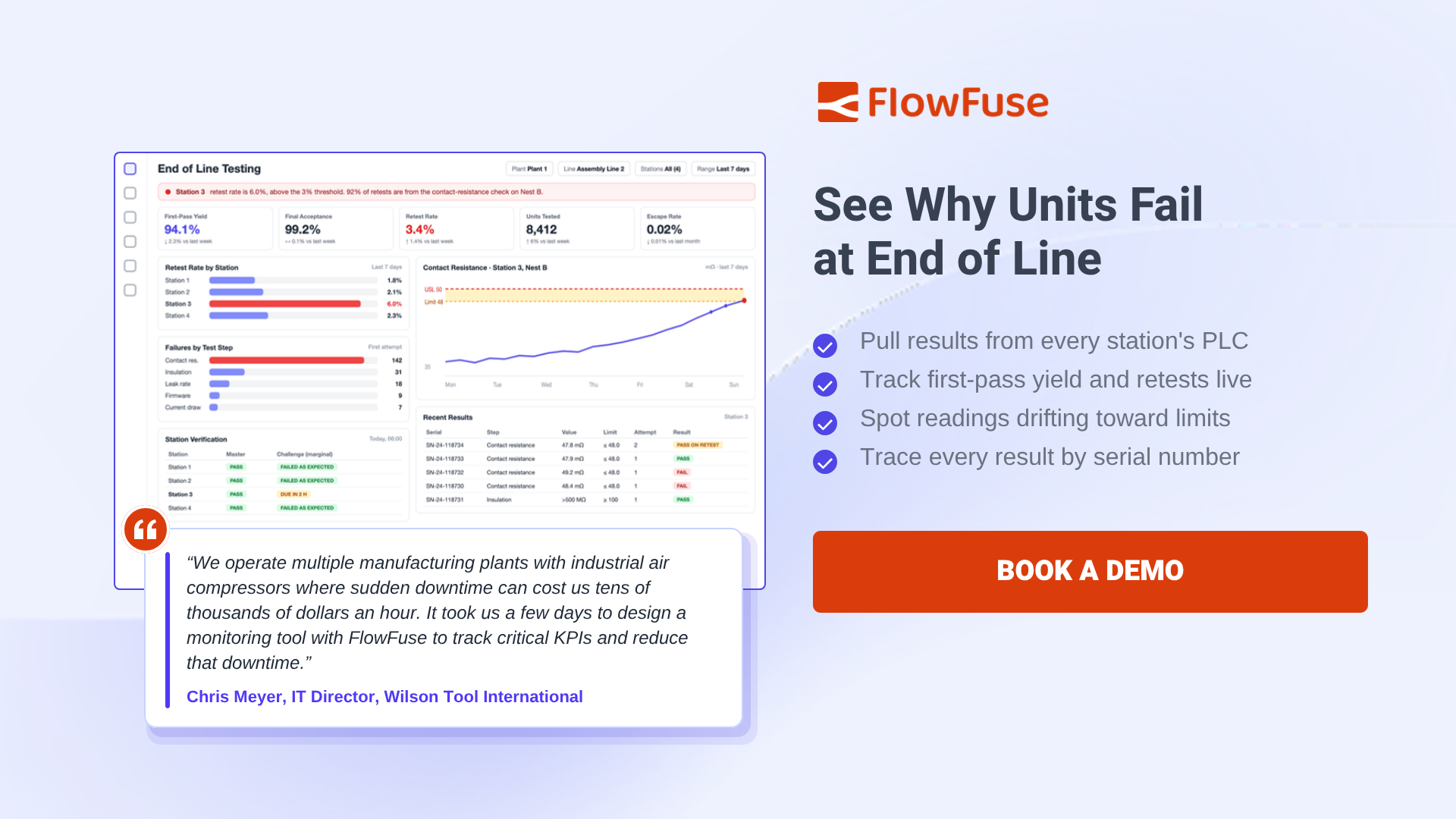
Here's the same question with FlowFuse. Station 3's retest rate climbs from 2% to 6% over a week while every other station stays flat. FlowFuse reads each station's results from its PLC over OPC UA, Modbus, Siemens S7, or EtherNet/IP, and stores every measurement with its serial number, limit, and recipe version. The dashboard shows the jump on day one, and the quality engineer gets an alert.
The data shows that nearly every retest came from the contact-resistance check on one fixture nest, with readings creeping toward the upper limit. The maintenance log, pulled from the CMMS, shows those pins are overdue for replacement. The team swaps the pins, the retest rate drops back, and the units that passed on retest are already listed by serial number.
You don't need a developer to build this. With FlowFuse Expert, an engineer describes what they want in plain language and it builds the Node-RED flows. Its Insights mode lets the quality team ask questions of the data directly. Once it works on one line, you can roll it out to other lines and plants.
Final Thoughts
Most EOL problems are easy to fix once someone spots them. The hard part is noticing, because the station keeps saying PASS.
So ask a few questions about your own line. Do you know your first-pass yield, or only the final number? When did each station last fail a challenge part as it should? How long would it take to list every unit that passed on retest last month? If you're not sure, start with the data. Once readings, limits, and retest history are in one place, most station problems are easy to find.
Failed EOL, Passed on Retest. Now What?
Something is wrong with the part or the station. FlowFuse connects your test stations, PLCs, and production data so you can see which, before the next batch ships.
Frequently Asked Questions
About the Author
Sumit Shinde
Technical Writer
Sumit Shinde is a Technical Writer at FlowFuse specializing in industrial automation and manufacturing. In the past three years, he has built industrial applications and authored more than 100 technical articles covering industrial connectivity, unified data architecture, production metrics, and quality management for modern manufacturing.
Like what you're reading?
Add FlowFuse as a preferred sourceOn the page that opens, check the box next to flowfuse.com to see more of our articles in your Google Search results.
Related Articles:
- Quality Assurance vs Quality Control: Fixing the Process or Checking the Product
- Buyer's Guide: How to Evaluate an Edge AI Platform for Industrial Use
- CQI-9 Heat Treat Audit: A Drifting Thermocouple Can Fail the Whole Furnace
- PPAP Checklist: Free Template and How to Review a Submission
- Manufacturing Defects: One Weld Crack, Four Ways to Classify It