AI in Manufacturing: Use Cases, Software, and Implementation
Explore use cases of AI in manufacturing, the software involved, and how to implement them in production.

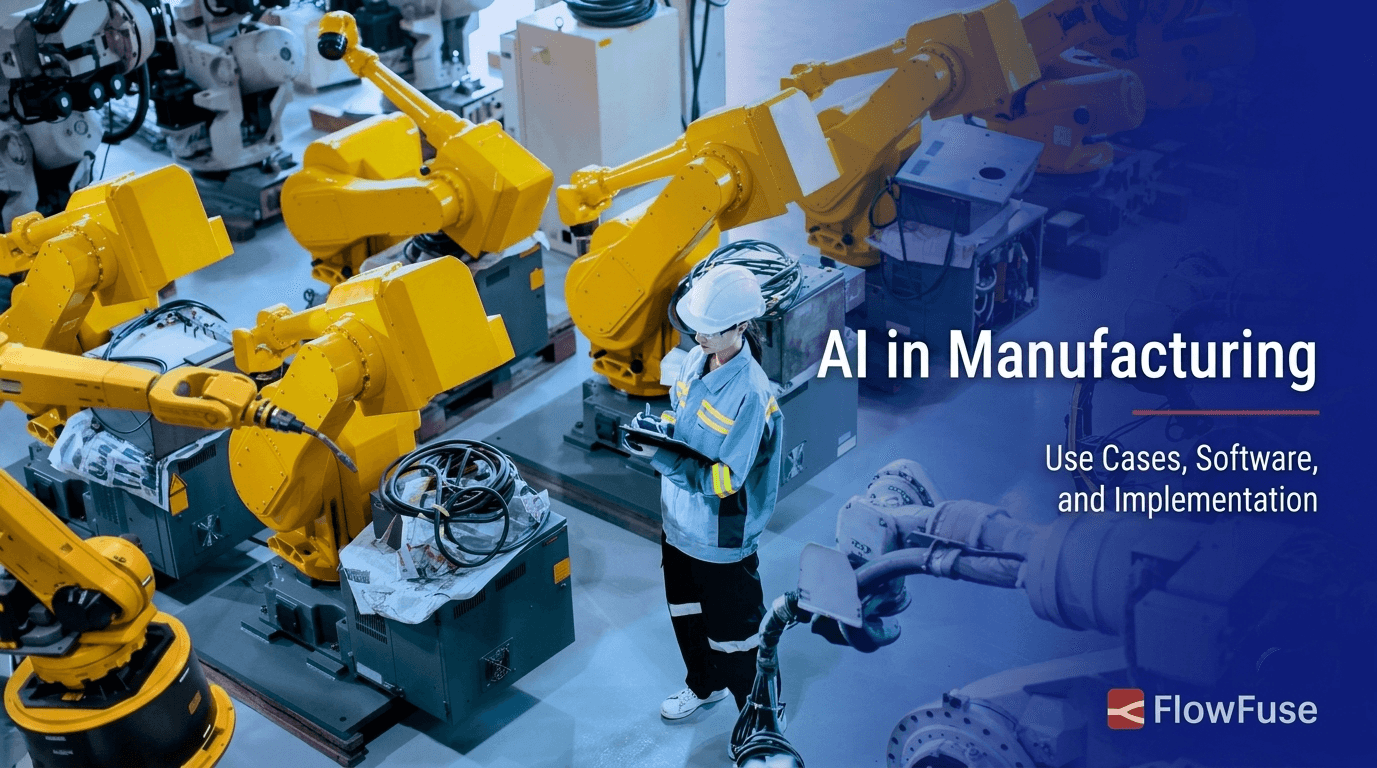
- AI in manufacturing is applied to machine, PLC, sensor, camera, MES, and SCADA data to predict failures, detect defects, optimize processes, and support production decisions.
- Putting a model into production takes more than the model itself: it needs industrial data connectivity, somewhere to run it, and a way to deliver results to the people and systems that act on them.
AI is being used in manufacturing to predict equipment failures, detect defects, optimize processes, and help operators and engineers make better production decisions. These applications use data from machines, PLCs, sensors, cameras, MES, SCADA, and other factory systems.
Implementing AI in a manufacturing environment is more than selecting the right model. It requires connecting data, building applications, and bringing results to where they can have the most impact. This article covers the main use cases for AI in manufacturing, the software required, and how to implement AI in production.
What Is AI in Manufacturing?
AI stands for artificial intelligence. It encompasses technologies that enable learning from data, recognizing patterns, making predictions, and performing tasks that require human intelligence.
Applied to manufacturing, AI can analyze production data to detect anomalies and defects, predict equipment failures, optimize processes, and support production decisions.
Common Use Cases of AI in Manufacturing
AI can be applied to many aspects of a manufacturing operation. The particular use case depends on the process, the problem to be addressed, and the data involved.
At a high level, AI can help manufacturers predict what may happen, detect problems as they occur, optimize processes and resources, assist operators and engineers through applications and analysis, and automate repetitive tasks. These capabilities span equipment maintenance, quality inspection, process optimization, and support for operators and engineers.
Predictive Maintenance
Equipment availability is one of the most critical metrics in manufacturing, and unplanned downtime is costly. Predictive maintenance uses AI to estimate when a machine is likely to fail, so maintenance can be scheduled before it does.
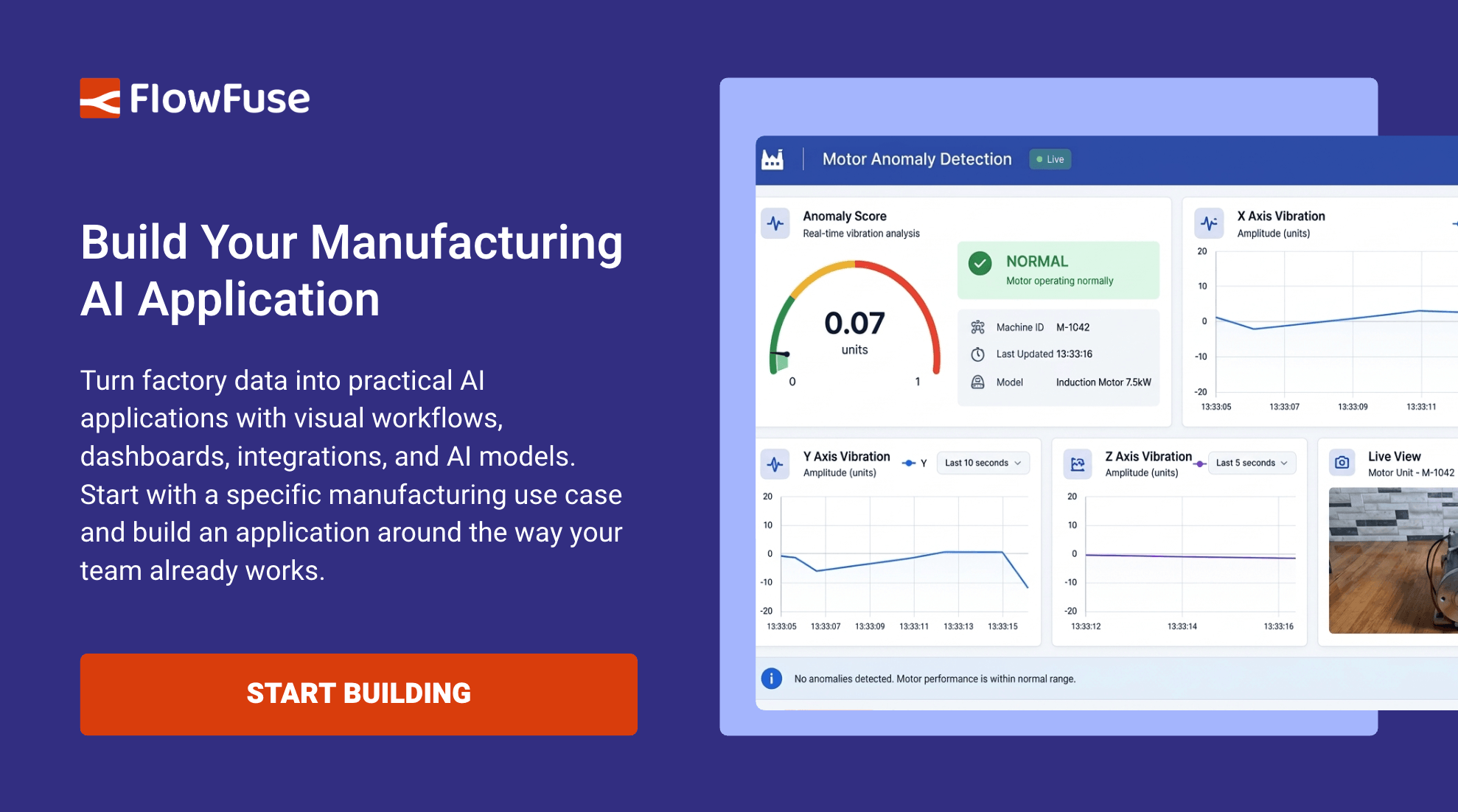
The model analyzes machine data over time to find patterns associated with equipment degradation. For example, it might analyze vibration, temperature, and current data from a motor to detect changes that predict a bearing is starting to wear. Maintenance teams can use that signal to investigate early, order parts in advance, and schedule the work during planned downtime rather than after a breakdown.
Anomaly Detection
Anomaly detection is similar to predictive maintenance, but it answers a different question. Instead of predicting a specific failure, it flags when equipment has stopped behaving normally, and it doesn't need examples of past failures to do it.
The model learns what normal looks like from signals such as temperature, pressure, vibration, current consumption, and cycle time, then raises an alert when readings stray from that pattern. Since it only needs normal operating data, it's a practical starting point when failures are rare or poorly documented.
For example, an AI-powered motor anomaly detector built with FlowFuse can detect abnormal behavior in a motor's current consumption, so teams can investigate before the issue turns into a larger production problem.
Quality Inspection
The same pattern recognition can be used to inspect product quality. AI-powered vision systems can detect defects, variations, or other characteristics that are hard to catch consistently through manual inspection.
For example, a camera can capture each product as it exits a conveyor while a vision model checks for surface defects. The results can be used to sort defective products and reveal recurring issues that point back to a particular machine, tool, or material batch.
Process and Energy Optimization
Process optimization is about making production itself as efficient as possible. AI can analyze process variables to see which ones contribute the most to the outcome, for example machine speed, temperature, material feed rate, and energy use, to find the combination that delivers the required output with the least waste.
Energy is a typical optimization target, since it's often one of the largest controllable costs. AI can flag wasteful energy usage such as idling equipment or compressed air leaks, and help shift flexible loads to lower-cost periods. These optimizations are typically measured in terms of energy per unit produced.
Demand Forecasting
AI can find patterns in historical demand data that indicate future trends. Manufacturers can use this to estimate demand for particular products or components in the coming weeks and months, accounting for seasonality, promotions, and market changes.
Production Planning and Scheduling
Building on demand forecasts, AI can help decide what to produce, when, and on which line. It can sequence orders, balance workloads, anticipate material shortages, and re-plan when a machine goes down or a rush order arrives.
The value is in handling many constraints at once, such as machine availability, changeover times, material lead times, and delivery dates. Many teams start with recommendations that a planner reviews before moving toward automated scheduling.
Digital Twins and Simulation
Digital twins create virtual representations of machines, production lines, or processes using data from their physical counterparts. AI can analyze this data to identify patterns, predict outcomes, and test “what if” scenarios, such as changes to line speed or production settings, before applying them to the real process.
Simulation can also supplement real-world data when failures are rare or difficult to capture. These applications are typically most valuable for complex or high-value processes where testing changes in production is costly or risky.
Operator Assistance
Operators, engineers, maintenance staff, and quality teams spend a lot of time searching for information: what an alarm means, what the procedure is, whether it's happened before. AI can shorten that search.
For example, when a machine raises an alarm, an operator can ask an AI assistant to explain the likely cause, pull the relevant troubleshooting procedure from a knowledge base, and surface recent data from that machine for review. The same approach works at a plant-wide level, where an engineer can ask which lines are underperforming this week and get an explanation of what's driving the gap.
Software Stack for AI in Manufacturing
AI is only one part of an AI application in manufacturing. To put a model into production, manufacturers also need software to collect and connect machine data, process and store it, run the model, and deliver its results to the systems and people who need them.
Industrial Data and Connectivity
An AI application needs data, which comes from sources including machines and PLCs, sensors, MES, SCADA, databases, cameras, and more.
Industrial connectivity software gathers this data and makes it available to the AI application. FlowFuse connects industrial equipment and routes this data through the application, which is essential for processing it. Its built-in MQTT broker can also act as the central hub where this data is published and made available to the AI application and other systems.
Edge and Cloud Computing
AI applications need computing resources to run models and generate predictions or other outputs. That computation can happen close to the machine at the edge or in the cloud, depending on the requirements of the workload.
Edge AI is useful where inference needs to happen with low latency and without a network connection, while cloud AI can provide access to more compute for demanding workloads. FlowFuse supports AI applications across both environments, running AI alongside industrial applications at the edge and connecting flows to cloud-hosted AI services when required.
AI and Machine Learning
The AI component itself depends on the use case, since it needs to be trained to perform a particular task such as predicting demand, detecting anomalies, or optimizing a process.
Various AI and machine learning software can implement these functions. For example, FlowFuse can run an ONNX machine learning model on an edge device using the ONNX node.
Data Storage
Depending on the application, data may need to be stored for later use, such as training models or displaying results to users. Various types of databases, including SQL and NoSQL, can be used for this.
FlowFuse can connect to databases already in use in the manufacturing environment, and also provides a built-in database for storing operational data.
Applications and Workflows
Finally, for an AI application to have an effect, its results need to reach the people and systems that can act on them. That could be a dashboard showing predicted demand, an alert indicating a machine is about to fail, or a maintenance task created automatically when an anomaly is detected.
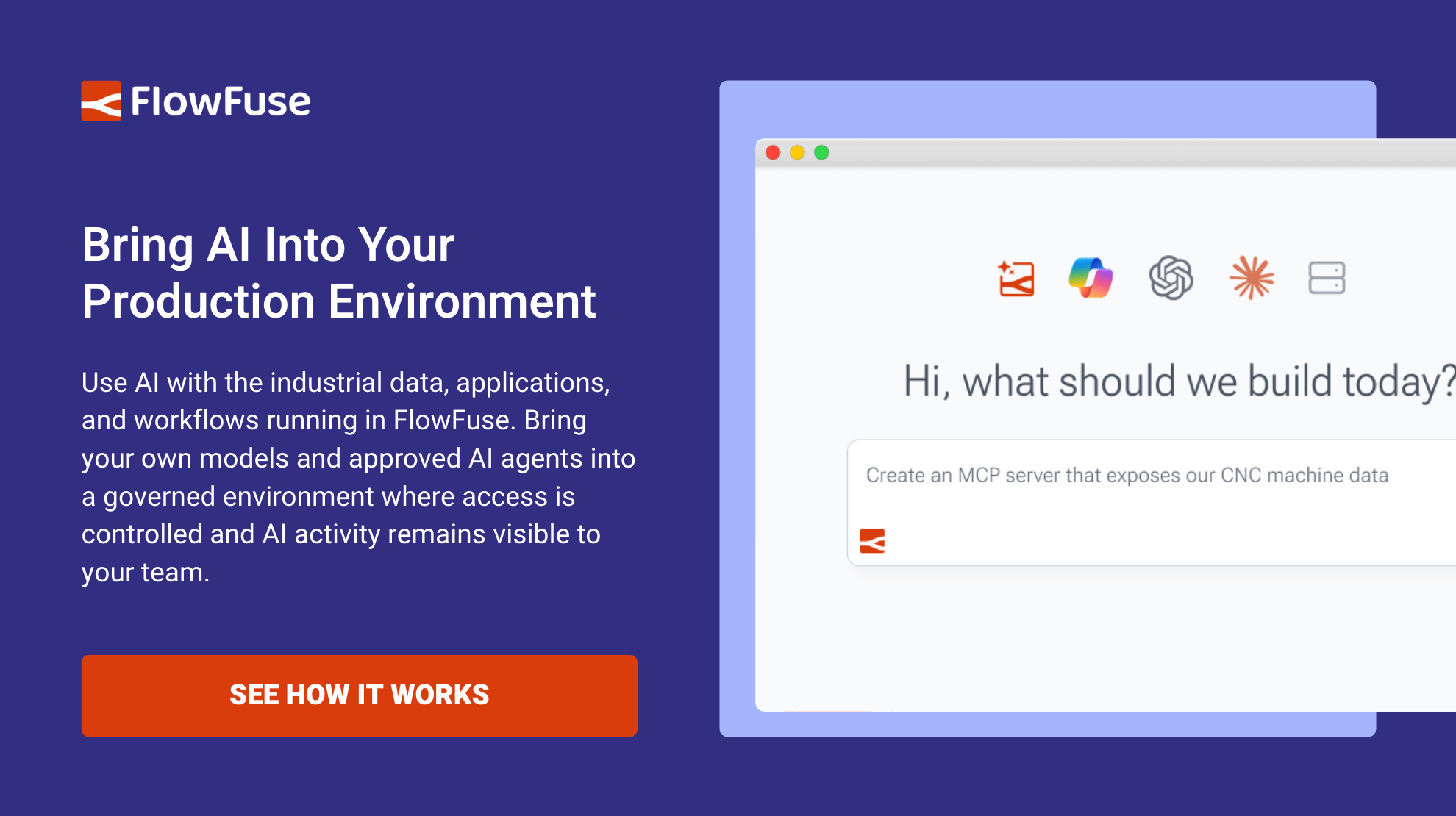
FlowFuse provides a visual application development environment for building these applications and workflows and connecting them to industrial data. FlowFuse also integrates with AI agents, allowing FlowFuse Expert and a coding agent of your choice to interact with the platform and build applications and data workflows through its MCP server and MCP nodes. This is how external AI services such as Claude, OpenAI, and Gemini connect to FlowFuse to work with manufacturing data and applications.
Not every application needs the full stack; it depends on the problem you're solving. At minimum, you need industrial data connectivity, somewhere to run the model, and the model itself. Beyond that, some applications also need data storage, dashboards, workflows, or AI assistants before the results can actually close the loop.
How to Implement AI in Manufacturing
A successful manufacturing AI project starts with a clear production problem, not an AI model. In practice, implementation can be approached in five stages:
- Define the outcome. Decide what you want to improve: reduce downtime, detect defects, increase throughput, help operators troubleshoot equipment faster. A specific, measurable outcome makes the project easier to scope and evaluate.
- Validate the data. Identify the data needed to support the use case and confirm it's available and collected consistently.
- Pilot a focused use case. Connect the relevant factory systems and test the AI on one machine, line, or process rather than across the entire plant. Starting small makes it easier to validate results, measure impact, and catch data or integration issues before scaling.
- Put results into the workflow. Once results are validated, connect them to where people can act on them: a dashboard that displays a prediction, an alert that indicates a likely failure, or a maintenance task created automatically when an anomaly is detected. A prediction only creates value when someone can act on it.
- Monitor and iterate. Treat the application as part of normal operations, not a one-time deployment. Equipment, processes, and production conditions change over time, and the models and applications built around them may need updating as new data becomes available.
The objective isn't to add AI for its own sake, but to apply it where it produces a measurable improvement in a real manufacturing process.
Connect Your Factory Data to an AI Application
Talk to the FlowFuse team about connecting your machines, PLCs, and factory systems to the AI use case you're evaluating.
Frequently Asked Questions
About the Author
Sumit Shinde
Technical Writer
Sumit Shinde is a Technical Writer at FlowFuse specializing in industrial automation and manufacturing. In the past three years, he has built industrial applications and authored more than 100 technical articles covering industrial connectivity, unified data architecture, production metrics, and quality management for modern manufacturing.
Like what you're reading?
Add FlowFuse as a preferred sourceOn the page that opens, check the box next to flowfuse.com to see more of our articles in your Google Search results.