Layered Process Audit Checklist: Free Template and Examples
Download a free LPA checklist template with practical questions for checking critical manufacturing processes.

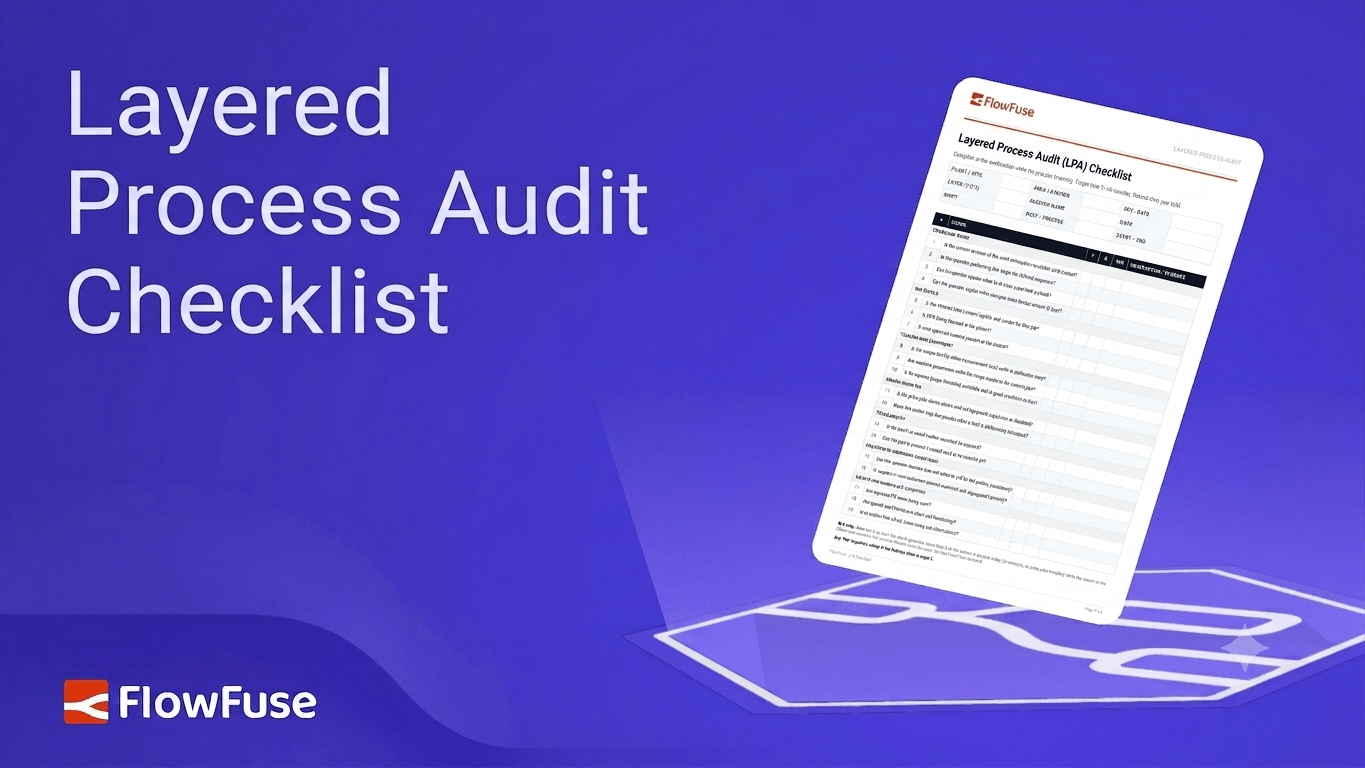
A layered process audit (LPA) checklist helps manufacturers consistently verify critical process controls. Learn what to include, how to write effective LPA questions, and download a free checklist template.
A Layered Process Audit (LPA) checklist gives supervisors and managers a consistent way to verify critical process controls on the shop floor.
A good checklist is focused rather than comprehensive. It should cover the controls that matter most to the process and use questions that can be answered by observing the work.
If you're building an LPA program, having a consistent set of questions makes it easier for different management layers to audit the same critical controls. Download the free checklist below as a starting point for creating your own LPA.
What Should Be on an LPA Checklist?
LPA questions should come from the controls that are important to the process. Useful sources include the PFMEA, control plan, work instructions, previous audit findings, customer complaints, and recurring scrap or rework.
Depending on the process, a checklist might cover:
- Standard work: Is the current work instruction being used?
- Materials: Is the correct material being used at the station?
- Equipment: Is the machine parameter within the approved range?
- Tooling: Is the torque tool within its required calibration period?
- Error-proofing: Is the poka-yoke device active?
- Traceability: Is the required batch or serial number recorded?
Not every checklist needs all of these areas. Select the controls that are most relevant to the process being audited.
How to Write LPA Questions
Questions should be specific enough that the auditor knows exactly what to check.
| Avoid | Better |
|---|---|
| Are the tools OK? | Is the torque tool within its required calibration period? |
| Is the operator following the process? | Is the operator following the defined assembly sequence? |
| Is quality being maintained? | Is the approved work instruction being used? |
The goal is to make each question objective and observable, rather than dependent on the auditor's opinion.
LPA Checklist Example
Consider an automotive assembly station where a component is fastened using a torque-controlled tool.
The checklist might verify that the current work instruction is being used, the correct component is at the station, the torque tool is within its approved range, and the error-proofing system is active.
During the audit, the supervisor finds the torque setting outside the approved range. They correct the setting, record the finding, and check what the station has built since the last verified check. Anything suspect gets segregated before it moves down the line.
A later audit verifies the setting held.
The checklist makes these critical controls easy to verify consistently without turning the LPA into a full process audit.
Keep the Checklist Relevant
A checklist should change when the process or its risks change.
Review it after significant process changes, recurring quality problems, new customer requirements, or findings that show the current questions are no longer sufficient.
Avoid adding questions simply to make the checklist more comprehensive. The goal is to check the controls that matter, not everything that could possibly be checked.
Build a Digital LPA with FlowFuse
Use FlowFuse to build digital LPA forms, connect audit results to machine and production data, trigger alerts, and track corrective actions.
About the Author
Sumit Shinde
Technical Writer
Sumit Shinde is a Technical Writer at FlowFuse specializing in industrial automation and manufacturing. In the past three years, he has built industrial applications and authored more than 100 technical articles covering industrial connectivity, unified data architecture, production metrics, and quality management for modern manufacturing.
Like what you're reading?
Add FlowFuse as a preferred sourceOn the page that opens, check the box next to flowfuse.com to see more of our articles in your Google Search results.
Related Articles:
- End of Line Testing: Your Final Defense Against Defects
- Quality Assurance vs Quality Control: Fixing the Process or Checking the Product
- Buyer's Guide: How to Evaluate an Edge AI Platform for Industrial Use
- CQI-9 Heat Treat Audit: A Drifting Thermocouple Can Fail the Whole Furnace
- PPAP Checklist: Free Template and How to Review a Submission