How Aperia Technologies Approached PLC Replacement with Zero Manual Setup Time
"FlowFuse is a one-click cloud deployment. The business impact was immediate. Zero manual setup time between shift handovers. Imagine R&D engineers monitoring real-time data curves and performance metrics remotely from home."
 Rhythm Agarwal · Senior Manufacturing Test Engineer at Aperia Technologies
The Challenge
Aperia Technologies, is a maker of automatic tire inflation systems for commercial fleets (its Halo Connect platform powers Goodyear's tire-as-a-service offering), and manufactures for fleet operators like Rider, NFI, and Rush Trucks. Their level of quality control, combined with global scale, created the same friction most manufacturing operations managers know well: every internal team was being asked to move faster, deploy across more lines, and generate more usable data, without adding headcount or risk. Aperia's factory floor was bottlenecked by two operational challenges tied directly to its legacy PLC-driven architecture:
Idle Capital Equipment: Multi-million-dollar end-of-line (EOL) test equipment sat idle for 8 to 12 hours a day between shifts, while the R&D team was told it couldn't get equipment time because "the line is busy."
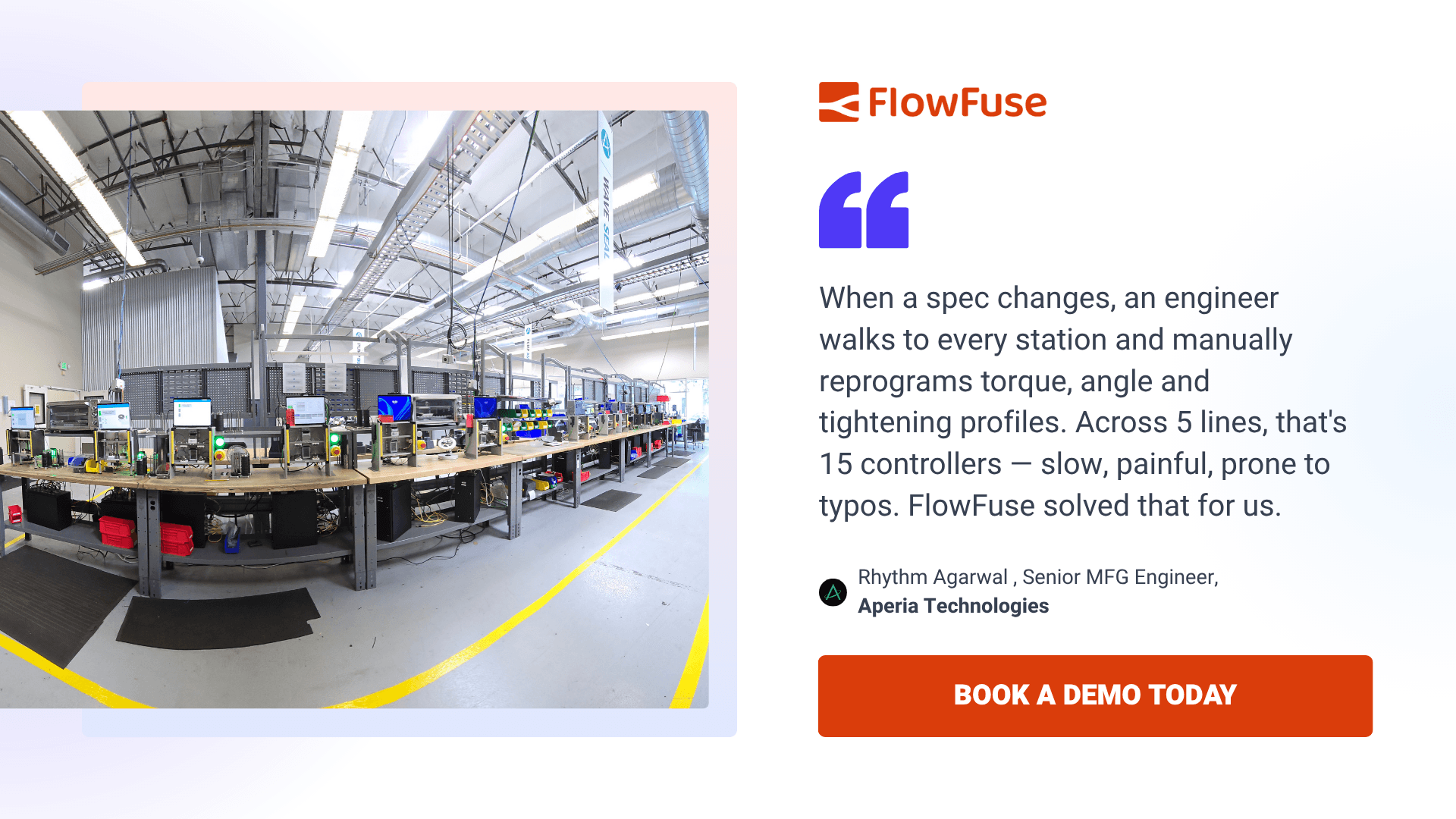
Manual, Station-by-Station Reprogramming: In a traditional PLC setup, when engineering issued an MCO or ECO that changed a torque spec by even a few newton-meters, an engineer had to physically walk to every station and manually reprogram the torque driver. At five lines with three screwdrivers each, that was 15 different controllers to update by hand, a process that was slow, painful, and prone to typos. How a PLC works comes down to a fixed scan cycle: reprogramming a PLC-driven station means walking to the hardware, connecting locally, and pushing changes one machine at a time, a model that scales linearly with the number of stations you own.
This manual overhead was limiting Aperia's ability to scale manufacturing operations and was creating delays that directly affected both production quality control and R&D velocity.
The FlowFuse Solution
Aperia's answer was to remove the proprietary PLC from the center of the architecture entirely. Instead, smart fixtures run Node-RED on an edge Windows instance, managed by FlowFuse. At the hardware layer, Node-RED talks directly to sensors, actuators, scanners, and motors using standard industrial protocols: Modbus TCP/RTU, RS232, raw TCP, and EtherNet/IP. At the software layer, it triggers label printing, logs serialized telemetry to MongoDB, syncs maintenance events to Limble, and pulls data from NetSuite ERP. FlowFuse functions as the orchestration layer that ties hardware protocols and enterprise APIs into one canvas, through two strategic implementations:
Turning Idle Test Equipment into R&D Capacity
Aperia's fix uses FlowFuse to automatically repurpose EOL testers overnight. During production hours, the equipment runs a strict pass/fail validation cycle. After hours, it automatically switches to multi-cycle reliability stress testing, routing that telemetry to an isolated R&D database so it never touches production data. R&D engineers can monitor real-time performance curves remotely, and if a machine goes down overnight or the system flags a test anomaly, Node-RED pushes an instant alert to the engineering team through Slack. New test sequences deploy across the fleet without writing custom PLC logic or licensing third-party software, exactly the kind of flexibility a PLC-first architecture can't offer.
Cloud-Controlled Torque Assembly Station
Aperia's solution was a vision-integrated screw assembly station connected to the cloud instead of a local PLC. Torque parameters, limits, and quality thresholds now live in a centralized database. When a part reaches the station, Node-RED pulls the correct spec from the cloud and pushes it to the controller automatically, using standard industrial protocols. A high-speed camera cross-checks geometric patterns to confirm spatial compliance in real time, and a local microcontroller UI serves three separate user groups: operators, quality technicians, and test engineers. In a live demo, Rhythm pushed a new torque revision to a full device group across the floor using FlowFuse pipelines in a few minutes, no USB stick, no station-by-station reprogramming, no risk of manual entry errors.
Key Results
Operational Impact:
- Zero Manual Setup Time: Eliminated manual reconfiguration between production and R&D shift handovers on EOL test equipment
- Unlocked R&D Capacity: Multi-million-dollar test equipment that previously sat idle 8-12 hours a day now runs reliability stress testing overnight
- Eliminated Station-by-Station Reprogramming: Torque spec changes that once required manually updating 15 separate controllers now deploy to a full device group in minutes
- Reduced Human Error: Removed the manual, USB-stick-driven reprogramming process that was slow and prone to typos
Security & IT Readiness:
- Layered Role-Based Access Control: Granular permissions at the instance, dashboard, team, and application level, mapping directly to existing IT role-privilege hierarchies
- Deployment Flexibility: Instances can be deployed air-gapped, through a customer's own IT infrastructure, or through FlowFuse's own broker, depending on data sensitivity
- Token-Based Device Authentication: AWS-generated secret tokens combined with IP whitelisting create a de facto two-factor model for device access
- Proven at Scale: Deployment held up against millions of simulated data points across thousands of machines without requiring architectural changes
Technical Architecture
The solution architecture includes:
- Edge Control Layer: Node-RED running on edge Windows instances, managed by FlowFuse, in place of proprietary PLC logic
- Industrial Protocol Support: Modbus TCP/RTU, RS232, raw TCP, and EtherNet/IP for direct communication with sensors, actuators, scanners, and motors
- Enterprise System Integration: MongoDB for serialized telemetry, DronaHQ for dashboards, NetSuite for ERP data, and Limble for maintenance event syncing
- Alerting: Slack API integration for instant anomaly and downtime alerts
- Deployment Management: FlowFuse pipelines for pushing device configuration updates to full device groups across the factory floor
- Access Control: Role-based access control at the instance, dashboard, team, and application level, with token-based authentication and IP whitelisting for device-level security
Looking Forward
Aperia's PLC replacement is really about removing friction at two different layers at once: turning idle capital equipment into usable R&D time, and turning a manual, error-prone reconfiguration process into a cloud-managed one. Neither required replacing existing enterprise systems (NetSuite, Limble, MongoDB); FlowFuse sits in between them as the orchestration layer. Manufacturing teams evaluating PLC replacement can start with FlowFuse's free 30-day trial.
FAQ: PLC Replacement with FlowFuse

Challenge
Idle test equipment and manual, station-by-station PLC reprogramming slowed production and blocked R&D velocity.
Solution
Removed the proprietary PLC and replaced it with FlowFuse, connected to enterprise systems and secured with layered access controls.
using:



Results
- Zero manual setup time between shift handovers, unlocking equipment that previously sat idle 8-12 hours a day
- Torque spec updates deployed to a full device group in minutes, replacing a manual process that required reprogramming 15 controllers across 5 lines by hand
- Security architecture proven against millions of simulated data points across thousands of machines, with no architectural redesign required