Automotive Traceability: How Production Data Gets Tied to a Part
How automotive manufacturers connect production data to individual parts, and what it takes to build traceability across existing factory systems.

- Identity Is the Foundation: Traceability starts with a unique identifier for each part, which turns isolated machine readings into an as-built record that can be searched later.
- Connection Beats Collection: Most factories already generate the data traceability needs. The hard part is associating a PLC reading, a scanner event, and an inspection result with the same part at the same moment.
- Extend, Don't Replace: An integration layer like FlowFuse connects existing PLCs, MES platforms, and databases into traceability workflows, so manufacturers build genealogy around the systems already running their lines.
A finished vehicle carries more than its physical components. It carries a production history: the materials used, processes performed, machines involved, and quality checks completed along the way.
Automotive traceability makes that history possible to reconstruct.
What Is Automotive Traceability?
Automotive traceability is the ability to follow a vehicle, component, or individual part through manufacturing and connect it with the data that production generates along the way. At vehicle level the anchor identifier is the VIN. At component level it is a serial number that serialization applies at the start of the process, and the finished result is often called the as-built record: everything known about how that specific unit came together.
Take a manufacturer producing brake assemblies. Each assembly receives a unique identifier, and as it moves through production the manufacturer ties that identifier to the supplier who provided the components, the line that assembled the part, the machine that performed each operation, the torque values the tool recorded, the inspection results, the operator, the timestamp of each operation, the batch number, and whether the part passed its quality check.
Now suppose a quality issue surfaces several days later. Instead of searching through disconnected machine logs, spreadsheets, and production records, the manufacturer looks up the affected part and reads its production history. That is the real value of traceability: it turns production data into a history someone can follow.
Why Traceability Matters in Automotive Manufacturing
Traceability matters more in automotive manufacturing than in most industries because a problem with one component can affect a large number of vehicles, and because the supply chain runs deep. An OEM depends on Tier 1 suppliers who depend on Tier 2 suppliers, and a defect can enter at any level. It is also expected rather than optional, since IATF 16949 requires manufacturers to define traceability so they can identify and contain suspect product.
The scale explains the pressure. NHTSA processes over 1,000 new recalls each year, and completion rates for most component categories land between 60% and 75%. A recall that covers more vehicles than it needs to therefore costs more and still leaves defective units on the road. Narrowing the scope is not only cheaper, it is more effective.
Consider a supplier discovering that a batch of components does not meet specification. The manufacturer needs to determine which parts from that batch entered production and which vehicles contain them. That is forward traceability: start with a suspect input and find everywhere it went. Backward traceability works the other way, starting from a returned vehicle and reconstructing what went into it. Without reliable records, either direction turns into a manual investigation across production logs, databases, and spreadsheets. With them, the manufacturer queries the relevant identifiers and gets the affected scope directly.
The same connected history speeds up root-cause analysis. When a component fails final test, a quality engineer starts at its identifier and works backward. Which material batch went into it? Which machine and station handled it? What were the process parameters, and did other parts from the same window show similar results? That makes traceability an engineering tool rather than a compliance checkbox.
It also works proactively. If failures start increasing on one assembly line, engineers compare failed parts against machine parameters, tooling changes, and operating conditions. When a process parameter drifts outside its normal range, teams catch the trend before it produces a large batch of defective parts.
Where Traceability Starts: Incoming Material
Most traceability projects begin at the first production station, which is one station too late. The chain has to start at receiving, because that is where the plant takes custody of material whose history it did not record.
When a shipment arrives, the plant captures the supplier, the supplier's lot or batch number, the material certificate where one applies, the quantity, and the date. That record becomes the top of the genealogy chain, and every part built from that material inherits the link. Skip it, and forward traceability stops at the plant boundary: you can prove which vehicles used lot B-184, but not who supplied B-184 or what else arrived alongside it.
This is the line between internal and external traceability. Internal covers everything inside the plant, from receiving through production and shipping. External extends the chain across organizational boundaries, so a Tier 1 supplier can answer questions about material that came from a Tier 2 supplier. Recall investigations almost always need both, which is why label and identification standards matter: a code applied at a Tier 2 plant has to stay readable at the Tier 1 plant and again at the OEM.
Incoming material also brings the batch-versus-unit question forward. A supplier may ship serialized components, or a lot of bulk material with one identifier covering thousands of pieces. Whatever granularity arrives at the dock sets the floor for how precisely the plant can trace anything built from it.
What Data Needs to Be Tracked?
A traceability system is only as useful as the data connected to each part. Requirements vary, but a few categories show up almost everywhere.
Part identity is the starting point: a serial number, Data Matrix code, or RFID tag that links a physical component to its digital record. Automotive commonly uses direct part marking, where a laser or dot-peen head cuts the code into the component itself so it survives washing, painting, and handling. Production information describes where and when the plant processed the part, covering line, workstation, machine, operator, and timestamp. Process data adds detail about the operation itself, which might mean torque, pressure, temperature, or cycle time. Quality data records whether the part passed its inspections and tests. Material and batch information connects the finished component back to its source, which matters most when a supplier batch later turns out to have a problem.
Not every part warrants a serial number. Safety-critical and high-value components such as airbags, brake assemblies, and battery packs usually get unit-level identity, while fasteners, adhesives, and bulk materials stay at batch or lot level. Choosing the wrong granularity costs money in both directions: serializing everything adds marking and scanning time at every station, while batch-tracking a safety-critical part widens the containment scope when something goes wrong.
None of these datasets should sit in isolation. The goal is to establish relationships between them, so a vehicle connects to an assembly, which connects to a component, a production step, a machine, its process data, and the resulting quality result.
Why Connecting the Factory Is the Hard Part
The information traceability requires comes from systems that nobody designed to work together. A PLC holds machine states and process values. A scanner identifies the part. A vision system produces an inspection result. An MES manages production information while a database holds historical records. Each works fine on its own.
A tightening controller may report that an operation finished at 10:42:13 with a torque value of 42 Nm. A scanner may have identified the part as BRK-10482 moments earlier. The traceability system has to establish that those two events belong together, which means treating machine connectivity, timestamps, identifiers, and storage as one workflow rather than five separate projects.
The problem compounds because one line often includes equipment from several vendors, each exposing information differently. One machine speaks OPC UA, another communicates over EtherNet/IP, and other equipment publishes through MQTT or exposes a vendor interface of its own.
None of this requires replacing the existing MES, SCADA, PLCs, or vendor systems. FlowFuse acts as a low-code IT/OT integration layer between them, connecting machines, protocols, databases, and MES platforms without a rip-and-replace project. Rather than pushing every piece of machine data into a central system, workflows process and route information when relevant production events occur.
Associating Production Data With Individual Parts
Collecting machine data is only half the problem. The system also needs to know which part that data belongs to, and a unique identifier provides the answer.
Take a simple assembly station. A scanner reads PART-84721, and the station opens an active context for that part. The identifier also selects the tightening program, so the tool runs the limits that belong to this specific assembly and stays locked until a valid scan arrives. When the operation finishes, the stored record shows part PART-84721 at station Assembly-04, tightened under program 7, with a torque of 42.1 Nm, an angle of 87.4°, an OK result, and a timestamp of 10:42:13.
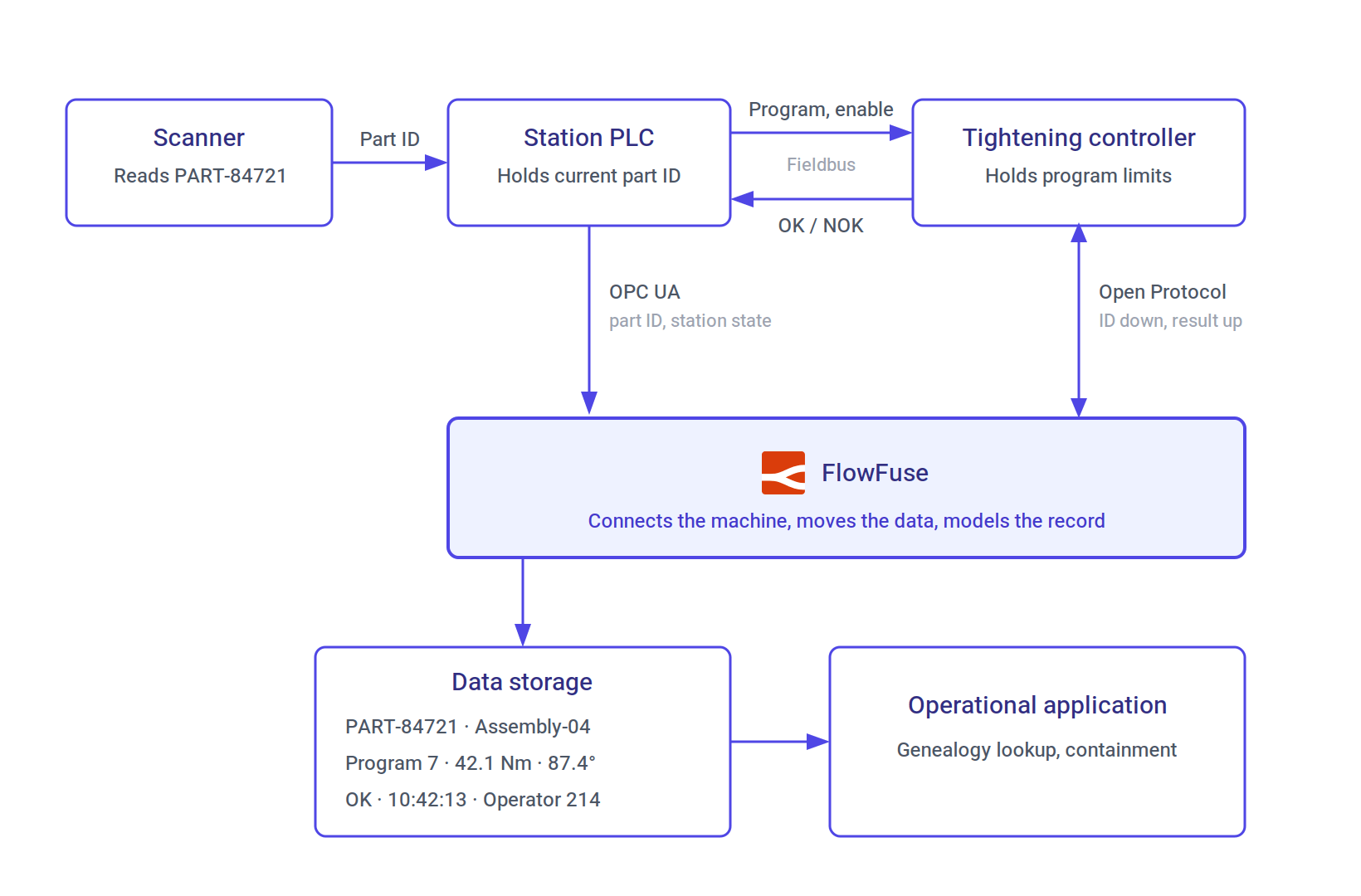 A scan opens the context; the tightening result lands against the part that was scanned.
Notice that the values arrive from two different systems. The identifier lives in the station controller, the torque and the verdict live in the tightening controller, and neither one means much without the other. That record is far more useful than an isolated 42.1 Nm reading, because the identifier supplies the context. A FlowFuse workflow handles the logic directly: take the identifier, collect the values from the relevant equipment, transform them into the required structure, and route the record to its destination.
The same identity check also enables error-proofing. If a part reaches station 5 without a passing record from station 4, the workflow blocks the operation instead of adding another entry to a history nobody reads until a recall. Traceability that only records is a reporting system. Traceability that interlocks stations stops defects from moving down the line.
Building Part Genealogy
Once manufacturers connect production records, they can build part genealogy, which describes the relationships between a finished product and everything that contributed to it.
Vehicle A contains battery pack 1042, which contains module M-07, built from cell lot B-184 supplied by cell supplier X. Line 3 and station 7 are not links in that chain. They belong to the point where one item was consumed into another, recorded alongside the timestamp, operator, and result.
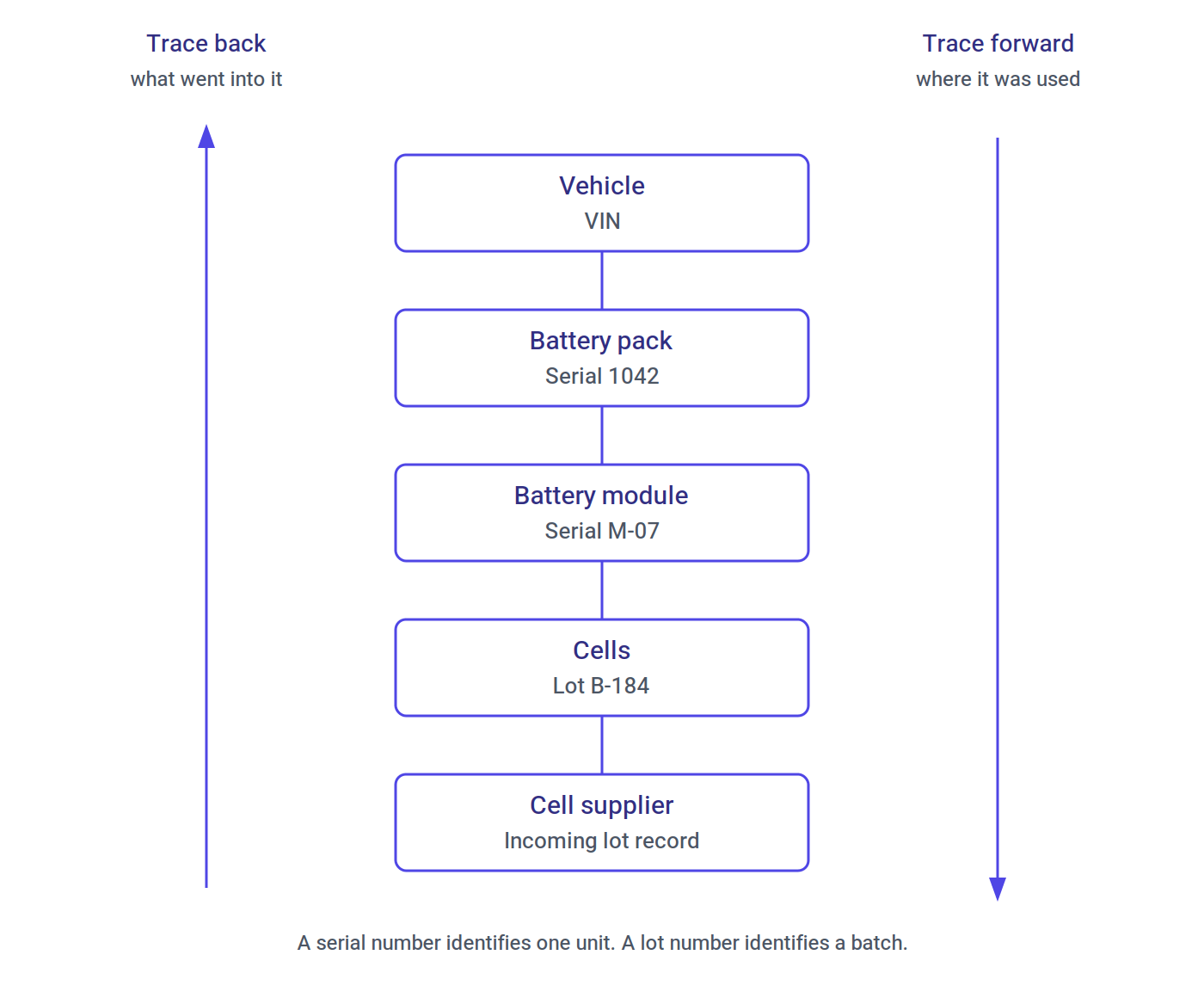 Genealogy links a finished vehicle to the components and suppliers behind it, and reads in both directions.
The chain reads both ways. Trace back from a returned vehicle to find every component behind it, or forward from a defective cell lot to find which modules used it, which packs took those modules, and which vehicles received those packs. The same principle applies down to individual fastening operations, welds, and inspection points.
Notice also where the identifiers change type. The vehicle carries a VIN and the pack and module carry serial numbers, so each one is traceable as a single unit. The cells carry a lot number, so they are traceable as a batch. Where serialization stops is where containment scope widens.
Structuring and Storing Traceability Data
Genealogy only works if the underlying data has structure. A traceability database typically holds parts and serial numbers, production orders, workstations, machines, process steps, materials and batches, measurements, quality results, and timestamps, and the relationships between those records matter as much as the values themselves. A production event that references a part ID, station ID, process ID, and timestamp lets someone reconstruct the history later without duplicating information across systems.
FlowFuse transforms and routes production data into the platform a manufacturer already runs, so teams structure information to fit their existing architecture instead of forcing every production system into one storage technology.
High-volume environments usually separate real-time operational data from long-term historical data. Real-time data supports production monitoring and immediate decisions, while historical data stays available for quality analysis, audits, and investigations. Retention is worth settling early, because customer contracts and regulatory requirements often set it rather than leaving it to the plant.
Scaling Traceability Across Production Lines
A solution that works at one station becomes hard to manage once it spreads across an entire factory. Different lines carry different equipment, protocols, and processes, while manufacturers still want one consistent approach to collecting production information.
Instead of running a separate integration project for every line, manufacturers can establish reusable workflows and deployment patterns. FlowFuse provides centralized management for industrial applications across production environments, which helps teams move past one-off integrations as applications reach multiple lines or plants. Workflows still adapt to the equipment at each site while following common patterns for deployment, management, and governance.
Final Thoughts
Automotive traceability is about more than knowing where a part came from. It makes production observable enough that manufacturers understand what happened, when it happened, and how the events connect.
That takes more than collecting data. Manufacturers need to connect machines and assets, move information between protocols and systems, structure the result, and deliver it to the people and applications that depend on it. An event-driven integration layer like FlowFuse supplies that connective tissue without replacing the systems already running the factory.
The payoff is an architecture that grows with the operation, from one station to a full line and eventually across multiple plants. When every relevant production event connects to the part it belongs to, manufacturers gain a complete, searchable history of how their products were made. The next time a quality issue appears, they are no longer asking what happened. They can start answering it.
Build Traceability On the Systems You Already Run
Connect PLCs, scanners, inspection systems, and databases into production workflows you can deploy across every line with FlowFuse.
About the Author
Sumit Shinde
Technical Writer
Sumit Shinde is a Technical Writer at FlowFuse specializing in industrial automation and manufacturing. In the past three years, he has built industrial applications and authored more than 100 technical articles covering industrial connectivity, unified data architecture, production metrics, and quality management for modern manufacturing.
Like what you're reading?
Add FlowFuse as a preferred sourceOn the page that opens, check the box next to flowfuse.com to see more of our articles in your Google Search results.
Related Articles:
- Layered Process Audit (LPA): A Practical Guide + Checklist
- VDA 5050 Tutorial: Connect AGVs to Factory Systems over MQTT
- 5 Manufacturing Dashboard Examples for Production, OEE & Quality
- What Is Statistical Process Control in Manufacturing
- Tracking Instrument Calibration with a Digital Dashboard