Why Manufacturing Needs GitOps
Bringing the same change management discipline manufacturers apply to machines to the software running alongside them

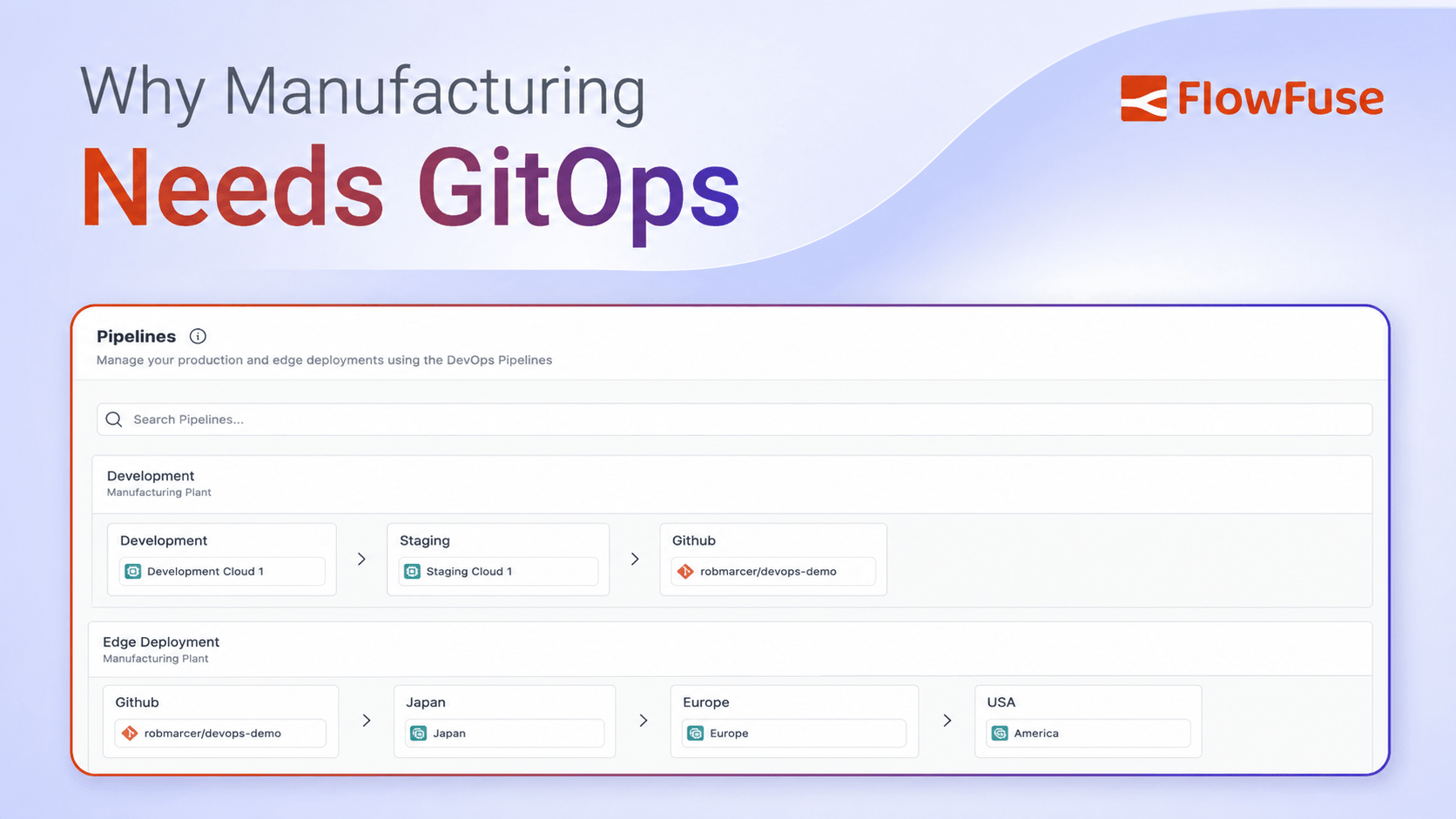
As software becomes core to manufacturing operations, it needs the same change management discipline manufacturers already apply to machines and processes. GitOps brings that discipline to industrial software, and FlowFuse DevOps Pipelines now support any Git server, including self-hosted ones, so manufacturers can adopt GitOps without changing their existing Git infrastructure.
Manufacturing has always been good at managing change.
If a machine is modified, a production process is updated, or a new recipe is introduced, there's usually a clear process to follow. The change is reviewed, documented, approved, and recorded before it reaches production. That discipline exists because every change can affect quality, uptime, and safety.
Software is now part of that same production process.
A modern factory doesn't just rely on PLCs anymore. Industrial gateways connect machines to business systems, edge applications process production data close to the source, dashboards give operators real-time visibility, and integrations move information between OT systems, MES, ERP, and cloud platforms. These applications are updated regularly as production requirements evolve and operations improve.
The challenge isn't that software changes. It's managing those changes consistently across the factory.
A maintenance engineer updates an application on one gateway to resolve an issue. A new production line needs an additional machine connection, so another device gets a slightly different configuration. An operator requests a dashboard improvement, and the change is made directly on the running system because production can't wait. On an automotive line, it might be an updated torque spec pushed to fix one part number, with no clear record afterward of which stations actually received it.
Each change solves an immediate problem. Over time, though, those small updates create a bigger one: one production line starts behaving differently from another, even though they're supposed to be identical. A gateway runs a different application version than the rest of the fleet. During troubleshooting, nobody is completely certain which version is running where, or whether every site received the latest update.
Those aren't software development problems anymore. They're operational problems. As industrial software becomes a bigger part of manufacturing, it needs the same level of change management that manufacturers have applied to machines and processes for decades.
Applying Change Management to Software
Managing software on a single gateway is straightforward. Managing it across dozens of production lines, multiple factories, or hundreds of edge devices is a very different challenge.
Without a consistent deployment process, software gradually drifts apart. A configuration is changed during troubleshooting but never documented. An engineer fixes an issue directly on a production device because it's the quickest way to restore operations. Each change makes sense in isolation, but over time identical production lines no longer run identical applications, and proving what was deployed, and when, means piecing together information from multiple systems or relying on people's memory.
Software engineering teams faced these same challenges years ago. Rather than treating running systems as the source of truth, they moved to a process where every change is made in a development environment, stored in a Git repository, reviewed before deployment, and promoted into production through a controlled workflow.
This approach is commonly known as GitOps. Despite the name, GitOps isn't really about Git. It's about making software deployments predictable, repeatable, and traceable. The Git repository becomes the record of the application versions that should be running. Every change has a history, every deployment follows the same approval process, and every production environment receives the version that was reviewed, not whatever happened to be changed directly on a device.
For manufacturers, GitOps extends the same principles they've always applied to physical process changes to the software running alongside them.
Bringing GitOps to the Factory Floor
GitOps provides the process, but manufacturers also need a platform that can apply it to industrial edge infrastructure. That's where FlowFuse fits.
FlowFuse is an industrial application platform that helps manufacturers build, deploy, monitor, and manage applications running across industrial edge devices, centrally rather than gateway by gateway.
DevOps Pipelines extend that platform by bringing a GitOps workflow to industrial applications.
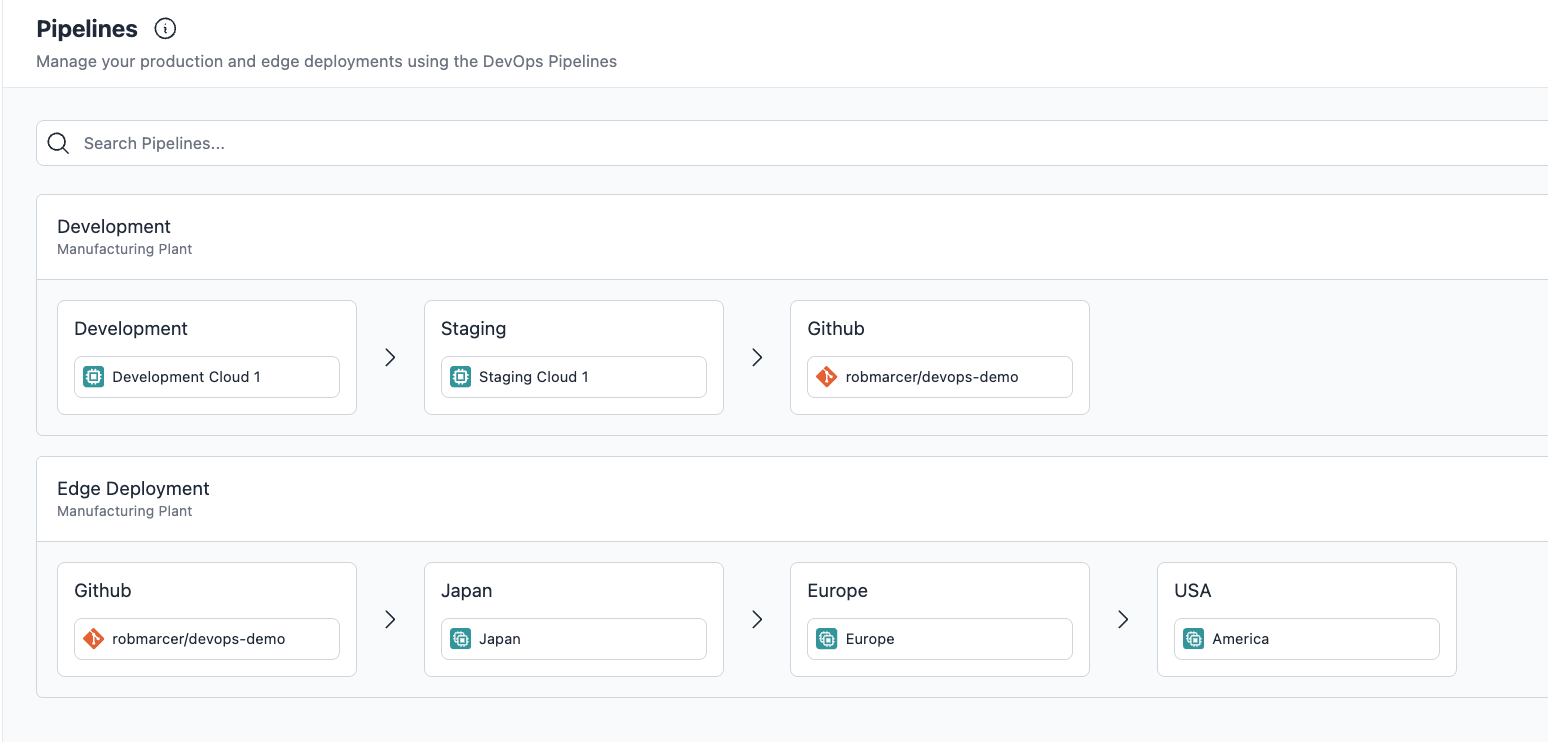 FlowFuse DevOps Pipeline showing a development stage, staging stage, and Git stage for pushing changes, and a second pipeline with a Git stage pushing deployments through multiple edge device groups across different regions."
Rather than making changes directly on production devices, engineers develop new application versions in a development environment and push them to their organization's Git repository, where changes can be reviewed using the team's existing approval process before deployment.
The Git repository becomes the source of truth for application deployments, while FlowFuse delivers those approved versions to the right devices consistently, whether updating a small pilot line or rolling out a new version across multiple factories.
Supporting the Git Infrastructure You Already Use
Until now, adopting a GitOps workflow on the factory floor often meant compromising on Git infrastructure. Many manufacturers already host Git internally using platforms such as GitLab, Bitbucket, or Gitea, often for cybersecurity, compliance, or network-architecture reasons. Moving repositories to a cloud-hosted service just to support a deployment workflow isn't practical for many organizations.
FlowFuse 2.32 removes that limitation. DevOps Pipelines now support any Git server accessible over HTTPS, cloud-hosted or self-hosted, and organizations using a private certificate authority can configure their certificates so FlowFuse can communicate securely with internal Git servers.
Getting started is straightforward: create a pipeline, add a Git Repository stage, connect it using a Personal Access Token, choose your repository and branches, and you're ready to deploy through Git. See the DevOps Pipelines documentation for step-by-step instructions.
A typical deployment process looks like this:
- An engineer develops and tests a new application version in a FlowFuse development instance.
- They create a DevOps Pipeline, starting with the development instance as the source snapshot. Additional stages, such as a staging instance, can be added if required.
- A Git Repository stage is added to push the application snapshot to the organization's Git repository.
- The change is reviewed and approved using the team's existing Git workflow (for example, through a pull request).
- For deployment, another DevOps Pipeline starts with the Git Repository stage as the source and deploys the approved version to the target Hosted instance, Edge Device, or Edge Group.
Every deployment comes from a reviewed version stored in Git, whether that's a handful of gateways on one production line or thousands of edge devices across multiple facilities.
Software Change Management Is Becoming an Operational Requirement
Modern manufacturing depends on more software than ever before. Every new gateway, edge application, dashboard, and system integration adds another application that needs to be deployed, updated, and maintained throughout its lifecycle. Managing that through manual updates may work for a handful of devices, but it becomes increasingly difficult as deployments scale across production lines, factories, and distributed sites.
GitOps provides a practical way to bring manufacturing's existing discipline around change management to industrial software, by making deployments consistent, changes traceable, and application versions easy to manage.
FlowFuse builds on those principles by helping manufacturers manage industrial applications across fleets of edge devices while integrating with the Git infrastructure they already use, moving from manually updating individual devices to deploying reviewed application versions through a repeatable workflow.
As industrial software continues to grow in importance, knowing exactly which version is running across every production line is no longer just a software engineering concern. It's part of running a modern manufacturing operation.
Bring GitOps to Your Industrial Applications
See how FlowFuse helps you build, deploy, and manage industrial applications with a GitOps workflow that scales from a single production line to fleets of edge devices.
Frequently Asked Questions
About the Author
Sumit Shinde
Technical Writer
Sumit Shinde is a Technical Writer at FlowFuse specializing in industrial automation and manufacturing. In the past three years, he has built industrial applications and authored more than 100 technical articles covering industrial connectivity, unified data architecture, production metrics, and quality management for modern manufacturing.
Like what you're reading?
Add FlowFuse as a preferred sourceOn the page that opens, check the box next to flowfuse.com to see more of our articles in your Google Search results.
Related Articles:
- End of Line Testing: Your Final Defense Against Defects
- Quality Assurance vs Quality Control: Fixing the Process or Checking the Product
- Buyer's Guide: How to Evaluate an Edge AI Platform for Industrial Use
- CQI-9 Heat Treat Audit: A Drifting Thermocouple Can Fail the Whole Furnace
- PPAP Checklist: Free Template and How to Review a Submission