MQTT vs Kafka: Complete Comparison Guide 2026
Compare features, performance, and use cases to choose the right protocol
MQTT is a lightweight pub/sub protocol built for resource-constrained IoT devices and unreliable networks, delivering low-latency messages with minimal overhead. Kafka is a distributed event streaming platform built for high-throughput, persistent data movement between backend systems, with message replay at the cost of higher latency and operational complexity. Neither is universally better: choose MQTT for edge device connectivity and Kafka for large-scale data processing. Most production systems use both, with MQTT at the edge and Kafka in the backend, bridged through tools like FlowFuse.
Building IoT systems means making hard choices about how messages flow through your infrastructure. Apache Kafka and MQTT couldn't be more different in their approaches. MQTT came from the world of sensors and resource-constrained devices. Kafka was designed to push massive data streams between backend systems. Getting this choice right early determines whether your architecture scales smoothly or hits a wall.
What Makes MQTT Different
MQTT (Message Queuing Telemetry Transport) showed up in 1999 when engineers needed to monitor oil pipelines with SCADA systems over unreliable satellite links. The whole point was squeezing messages through terrible networks without killing battery life.
The protocol uses binary encoding with headers as small as 2 bytes. That's it. This matters when you're running on an ESP32 with 520KB of RAM or sending data over a 2G connection that costs per kilobyte. MQTT runs over TCP/IP and supports TLS when you need encryption.
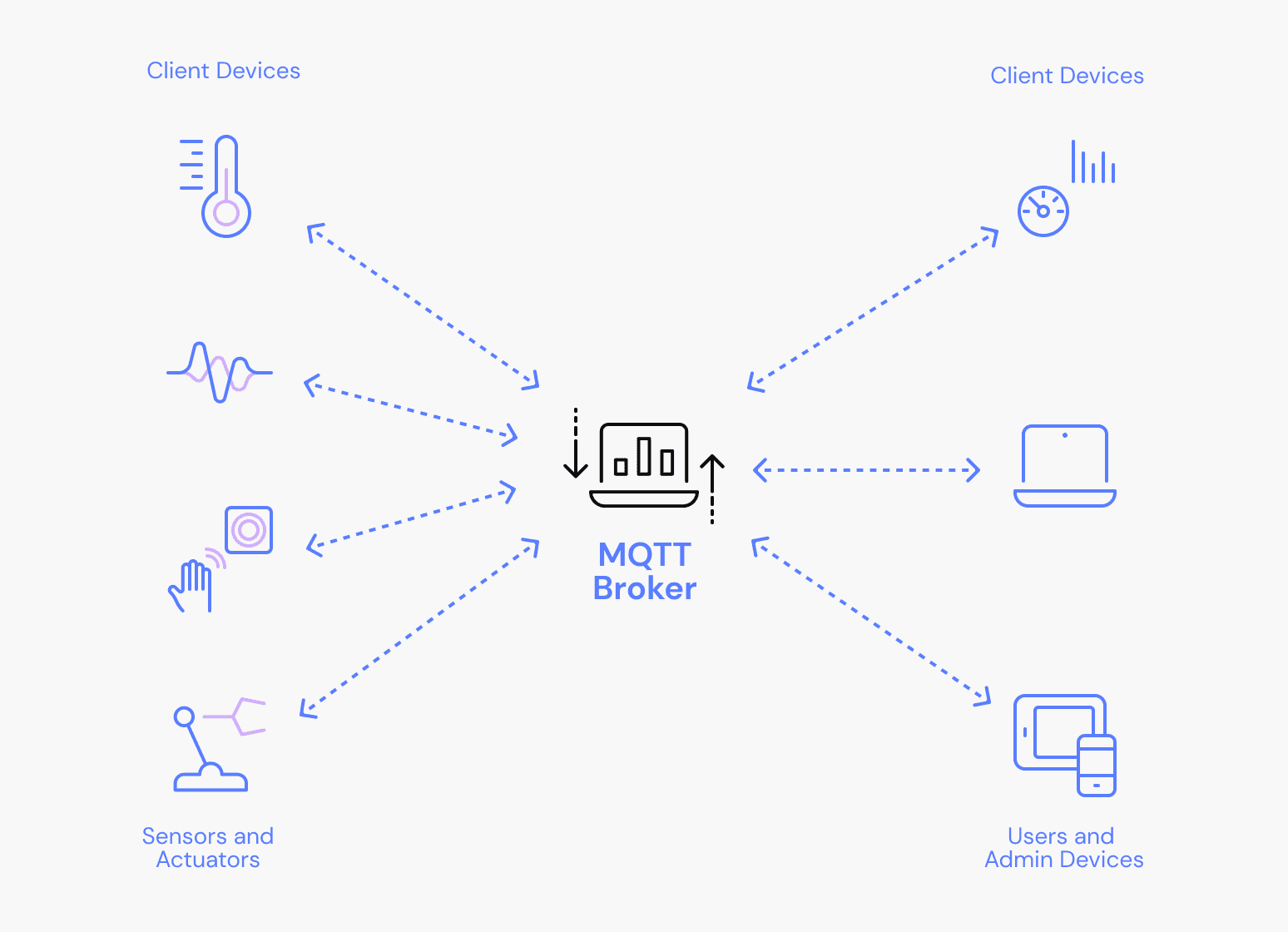
Here's how it works: A central broker sits in the middle. Devices publish messages to topics like factory/line-1/temperature. Other devices subscribe to those topics. The broker figures out who gets what. Topics use forward slashes to create hierarchies, so you can subscribe to factory/# and catch everything happening in the factory. You can also use wildcards: # matches multiple levels (like factory/# for everything under factory), while + matches exactly one level (like sensors/+/temperature for temperature readings from any single sensor).
MQTT has three Quality of Service levels:
QoS 0 - Fire and forget. Send the message once, hope it arrives. No acknowledgment, no retry. Fast but unreliable.
QoS 1 - At least once delivery. The broker acknowledges receipt and retries if needed. You might get duplicates.
QoS 2 - Exactly once through a four-way handshake. Slowest but guaranteed.
Pick based on what you're sending. Temperature readings every 10 seconds? QoS 0 is fine. Critical alarm messages? QoS 2.
How Kafka Works
LinkedIn built Kafka in 2011 because they were drowning in activity streams and operational metrics. Traditional message queues couldn't keep up. So they designed something that acts more like a distributed database than a message broker.
Kafka organizes everything into topics, and topics split into partitions. Each partition is just an ordered log of messages that never changes once written. Producers append messages to the end. Consumers track where they are in each partition using offsets. Multiple producers and consumers can hammer different partitions simultaneously, which is how Kafka gets ridiculous throughput.
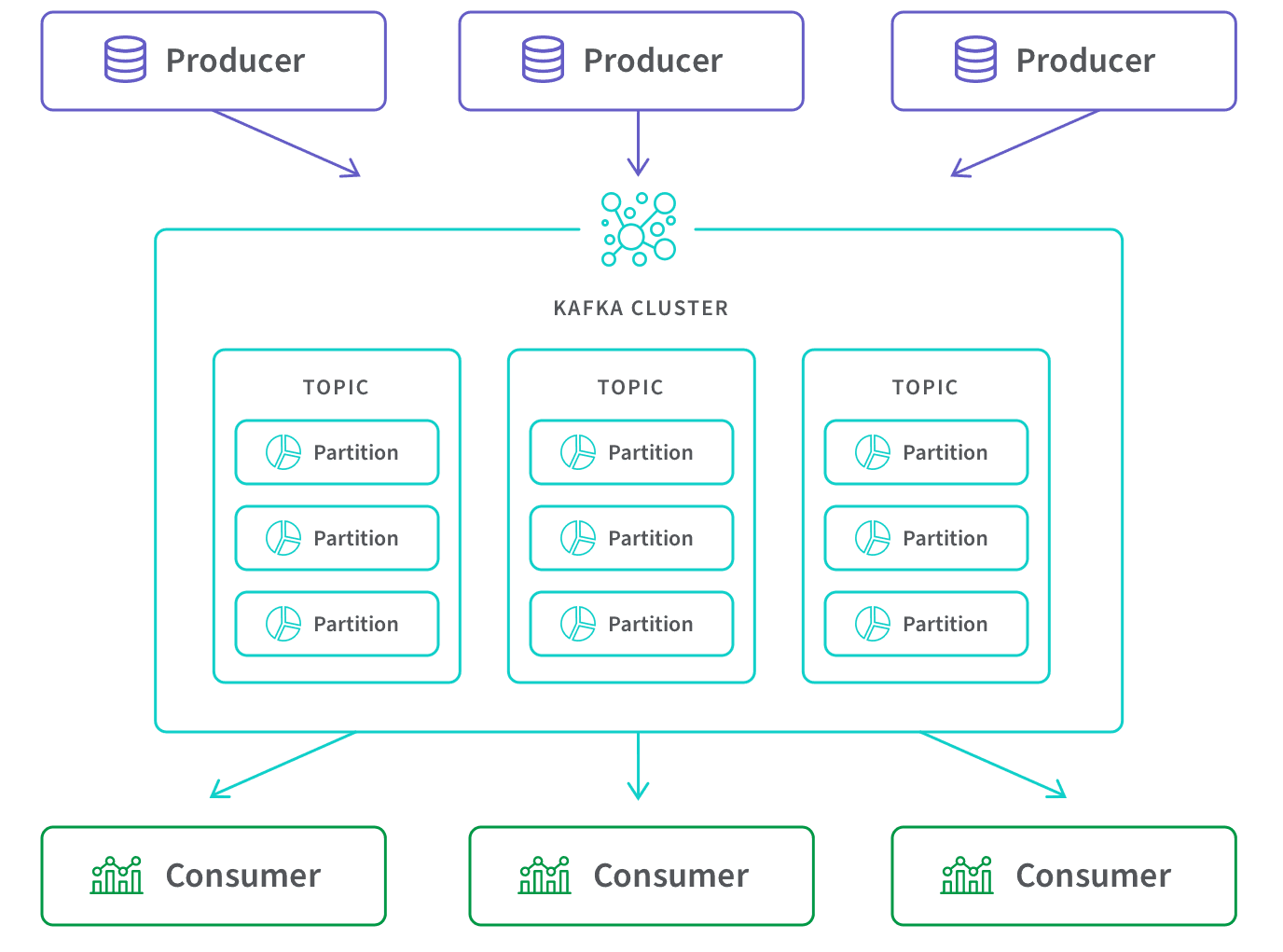
The architecture spreads partitions across multiple broker servers. Each partition gets replicated to other brokers based on your replication factor. If a broker crashes, another one takes over for its partitions immediately. No data loss, no downtime.
Unlike MQTT, messages don't disappear after delivery. Everything writes to disk. You configure retention policies, keep messages for 7 days, 30 days, or forever. This means you can replay messages, let new consumers read historical data, or reprocess everything if your analytics code had a bug.
Early Kafka needed Apache Zookeeper for cluster coordination, which added complexity. Recent versions support KRaft mode that removes this dependency, though many production systems still run Zookeeper.
The Real Differences
Architecture Philosophy
MQTT keeps things simple with a central broker. Devices connect, the broker routes messages, everyone's happy. You can get started with a single Raspberry Pi running Mosquitto. The 2-byte headers and compact binary format mean your sensor data flows efficiently even on constrained networks.
Kafka is distributed by design. Topics partition across brokers. Consumers track offsets themselves. Everything replicates for fault tolerance. You need coordination infrastructure (Zookeeper or KRaft), multiple brokers for production, and someone who knows distributed systems. But this complexity buys you throughput that single-broker systems simply can't match.
Performance Reality
MQTT delivers messages in milliseconds. It runs on microcontrollers with kilobytes of RAM. A sensor reading might be 10-20 bytes including protocol overhead. A decent broker handles thousands to tens of thousands of messages per second, which works fine when you have hundreds of thousands of devices sending data every few seconds.
Kafka sacrifices latency for volume. Messages take tens to hundreds of milliseconds because of disk writes, replication, and consumer polling. But a single broker can handle hundreds of thousands of messages per second. Clusters process billions daily. You need real hardware, multiple cores, 32GB+ memory, fast SSDs, but you get data movement at enterprise scale.
How Messages Get Delivered
MQTT's three QoS levels give you options. QoS 0 is fast but lossy. QoS 1 guarantees delivery but might duplicate. QoS 2 does exactly-once with a four-way handshake. Brokers can queue messages for offline subscribers, but they're not designed for long-term storage.
Kafka writes everything to disk based on your retention policy. Producers pick acknowledgment levels: wait for the leader broker (fast, less safe) or wait for all replicas (slower, fully durable). Consumers commit offsets after processing messages. Modern Kafka supports exactly-once semantics through transactions and idempotent producers. The persistence model enables message replay and handles consumer failures completely differently than MQTT.
Running This Stuff in Production
Setting up an MQTT broker is straightforward. You can start with something like Mosquitto for development, or choose from production-ready brokers that support clustering and high availability. Configure authentication, add redundancy as needed, and monitor connection counts, message rates, and queue depths, most brokers expose metrics via REST APIs or monitoring endpoints.
FlowFuse includes a managed MQTT broker built right into the platform, no separate infrastructure to set up or maintain. It connects directly with your Node-RED flows, so you can publish and subscribe to topics without leaving the environment. Check out the details to see how it works.
Kafka demands more. You need at least three brokers plus coordination services. Monitor partition distribution, replication lag, consumer group status, disk usage. Plan capacity for both storage and network bandwidth. Rolling upgrades require care. Partition reassignment needs coordination. The learning curve is real, but the system handles failures gracefully once you understand it.
Where to Use Each One
MQTT dominates in manufacturing plants with sensor networks, building automation, remote sites on cellular connections, and fleet tracking. It's the right call when devices have limited CPU and memory, networks constrain bandwidth, you're dealing with thousands of messages per second, and you don't need long-term storage.
Kafka powers financial transaction processing, e-commerce backends, infrastructure monitoring at scale, and data engineering pipelines. Use it when message volumes hit hundreds of thousands per second, multiple systems need independent access to the same data stream, you need replay capabilities, or you're feeding data into analytics platforms.
Most real systems use both. MQTT handles the edge, Kafka moves data between central systems. You see this pattern everywhere, MQTT at factory sites, Kafka in the data center.
Making the Choice
Here's how to think about it:
Pick MQTT when:
- Your devices are resource-constrained (microcontrollers, embedded systems)
- Network bandwidth is limited or expensive
- You're handling thousands of messages per second
- Simple deployment matters
- You need efficient edge device communication
- Long-term message storage isn't a requirement
Pick Kafka when:
- Message volumes hit hundreds of thousands per second or more
- Multiple applications need independent access to message streams
- You need message replay or event sourcing capabilities
- Stream processing is part of the architecture
- Integration with big data tools matters
- Your ops team knows distributed systems
Neither is "better." They solve different problems. Your requirements drive the decision.
Integrating MQTT and Kafka
As mentioned, real production systems don’t choose between these, they use both. Devices and sensors typically publish data over MQTT, while analytics platforms, data lakes, and stream processors consume events from Kafka. The real challenge lies in bridging the two reliably and cleanly.
Most teams write custom bridge services or deploy Kafka Connect with MQTT source connectors. Custom bridges give you complete control but require development and maintenance. Kafka Connect reduces code but adds configuration complexity, especially when you need transformation logic beyond simple field mapping.
FlowFuse takes a different approach using Node-RED's visual programming model. MQTT and Kafka nodes connect through flows that define routing and transformation logic. The platform manages protocol connections and flow execution without separate bridge infrastructure.
As mentioned before, FlowFuse includes a managed MQTT broker built directly into the platform. Beyond MQTT and Kafka, it supports industrial protocols like Modbus, OPC UA, and HTTP. Device connections, message processing, and Kafka integration all happen in one environment. You get built-in version control, deployment management, team collaboration, and much more.
FlowFuse offers a free trial for testing MQTT-Kafka workflows. Start building or schedule a consultation to discuss your specific needs.
Conclusion
MQTT and Kafka solve different problems. MQTT gives you efficient device connectivity with minimal overhead. Kafka delivers high-throughput event streaming with persistence and replay.
Understanding these differences helps you pick the right tool for the job. Most production systems use both, leveraging each where it provides the most value. Base your decision on message volumes, device capabilities, operational requirements, and team expertise, not on whatever's trending on Hacker News.
Discuss your use case with our team
See how FlowFuse can support your architecture, integrations, and deployment needs.
About the Author
Sumit Shinde
Technical Writer
Sumit Shinde is a Technical Writer at FlowFuse specializing in industrial automation and manufacturing. In the past three years, he has built industrial applications and authored more than 100 technical articles covering industrial connectivity, unified data architecture, production metrics, and quality management for modern manufacturing.
Like what you're reading?
Add FlowFuse as a preferred sourceOn the page that opens, check the box next to flowfuse.com to see more of our articles in your Google Search results.