node-red-contrib-abb-gofa
Node-RED nodes for controlling an ABB GoFa (CRB 15000) collaborative robot via RWS and a RAPID TCP socket server
node-red-contrib-abb-gofa
Node-RED nodes for controlling an ABB GoFa (CRB 15000) collaborative robot with an OmniCore controller over the local network. Motion, telemetry, I/O, RAPID program control, saved-point teach & replay — no extra ABB licenses required.
Developed and live-tested against a GoFa 12 (CRB 15000-12/1.27) on an OmniCore C30, RobotWare 7.21.
⚠️ Safety and security
This package moves a real robot arm.
- The software STOP command and Node-RED itself are not safety functions. The robot's own safety controller, reduced-speed collaborative limits, and the physical emergency stop are the only real safety layer. Never rely on a flow to keep people safe.
- The RAPID socket server (port 1025) accepts motion commands from anyone who can reach the robot's IP — there is no authentication on that port. Run the robot on an isolated or firewalled network segment. The same goes for RWS credentials sent over HTTPS with certificate checking disabled (the controller uses a self-signed certificate).
- Jog/rotate step limits (50 mm / 30°) are enforced in the RAPID module, not in Node-RED — if you edit
MainModule.mod, keep them. - The node property panels have live-action buttons (jog, move, motors on/off, …) backed by Node-RED admin HTTP endpoints. The browser confirmation dialogs are convenience only, not a security control. Configure
adminAuthon any Node-RED instance controlling a real robot — it is required, not optional. As of 2.4.10 these motion endpoints are refused (HTTP 403) whenadminAuthis not configured, so an unauthenticated editor port can no longer trigger motion. If your instance has noadminAuthbut is genuinely protected another way (isolated cell network / firewall / reverse proxy), tick Allow insecure live control on thegofa-robotconfig node to re-enable them at your own risk. Deployed flows are unaffected either way — this guard only covers the editor buttons.
How it works
Two transports, one rule — motion goes through a TCP socket, everything else goes through RWS:
- TCP socket (port 1025) — a small RAPID program (
rapid/MainModule.mod, bundled with this package) runs a socket server on the controller. Each motion node opens a connection, sends one newline-terminated command (HOME,GOTOJ…,J1+10, …), reads oneOK:/ERR:reply, and closes. - Robot Web Services (HTTPS, port 443) — OmniCore's built-in REST API, used for telemetry (pose, joints, state), motor on/off, RAPID start/stop, I/O read/write, file transfer, and WebSocket subscriptions.
RWS-only nodes (status, pose, joints, I/O, …) work without the RAPID module; motion nodes need it loaded and running.
Requirements
- ABB GoFa CRB 15000 with an OmniCore controller, RobotWare 7.x
- Node-RED ≥ 3.0, Node.js ≥ 18
- Network access to the controller (HTTPS 443 + TCP 1025)
- RobotStudio (free) — once, to create an RWS user with the right grants
Install
From your Node-RED user directory (usually ~/.node-red):
npm install node-red-contrib-abb-gofa
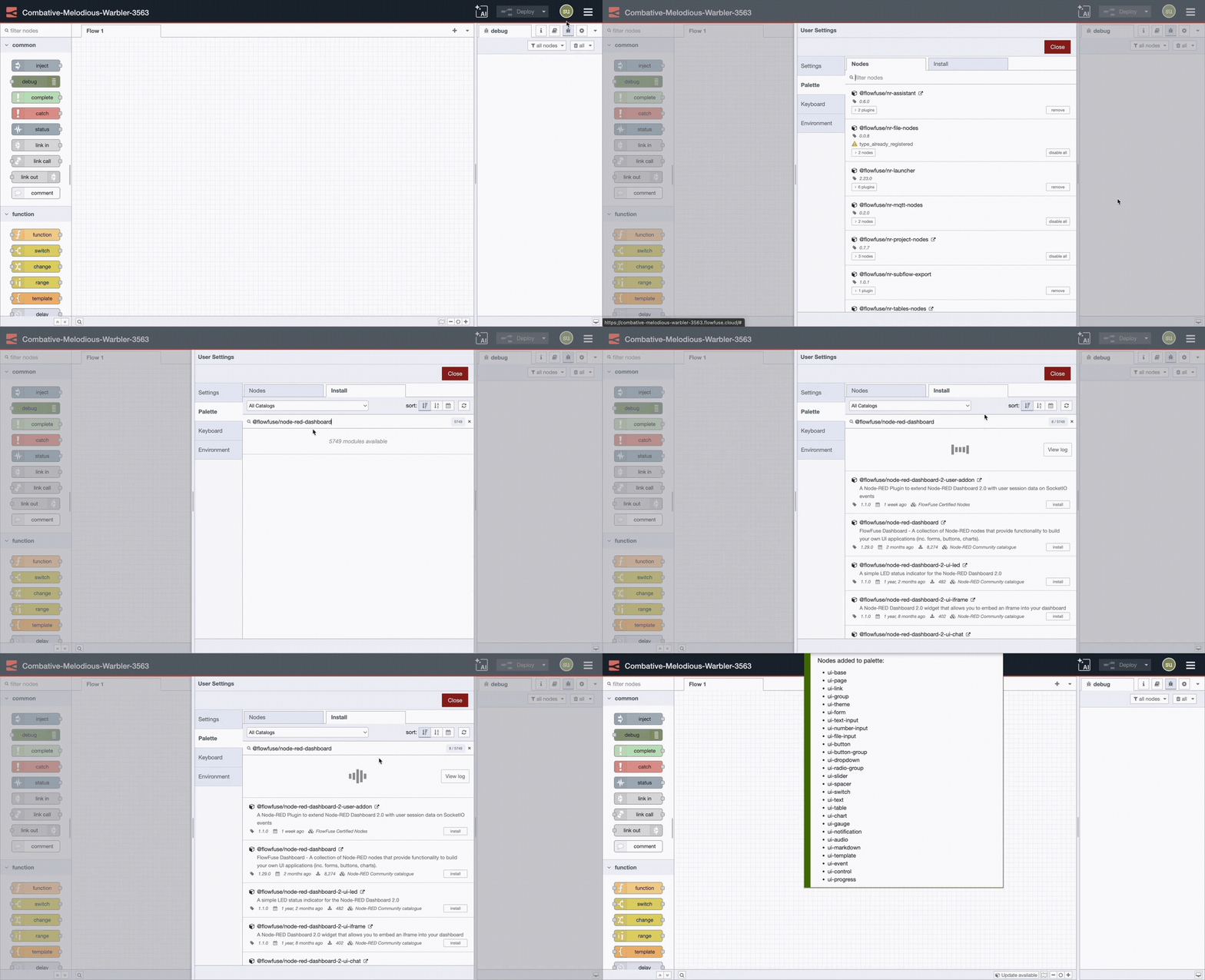
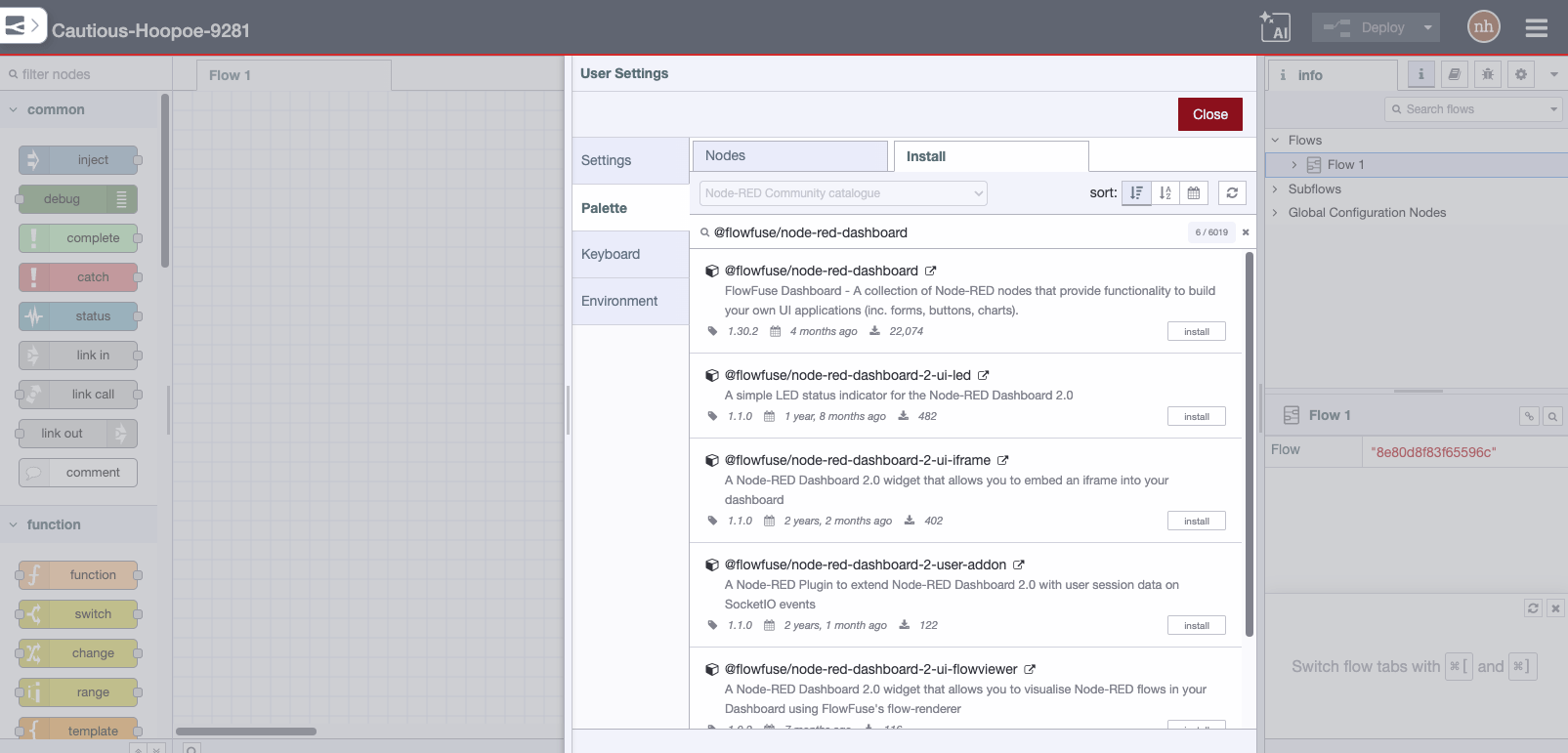
(or Menu → Manage palette → Install inside the Node-RED editor.)
Restart Node-RED — a gofa-robot config node and 43 gofa-* nodes appear under the GoFa category.
Controller setup (once)
1. Create an RWS user. The built-in Admin account cannot start/stop RAPID remotely. In RobotStudio: connect to the controller → Authenticate → Edit User Accounts → add a role with the Remote Start and Remote Stop grants → create a user with that role. Read-only nodes work with any account.
2. Upload the RAPID module. The module ships in this package. Easiest path: add a gofa-file node (action upload) and set its Local Path to the absolute path of the bundled file (e.g. /home/pi/.node-red/node_modules/node-red-contrib-abb-gofa/rapid/MainModule.mod — a relative path resolves against the Node-RED process directory, not your user dir). It uploads over RWS and automatically patches the module's SERVER_IP constant to your robot's IP (the RAPID socket server cannot bind a wildcard address, so this must match). Or upload manually:
curl -sk -u <user>:<password> -X PUT -H "Content-Type: text/plain;v=2.0" \
  --data-binary @rapid/MainModule.mod \
  "https://<ROBOT_IP>/fileservice/\$HOME/Programs/MainModule.mod"
(If you upload manually, edit SERVER_IP in the file to your robot's IP first.)
3. Load and start it on the FlexPendant. Code → ⋮ → Load Module → HOME/Programs/MainModule.mod, then Debug → PP to Main, switch to Auto mode, Motors on, Play (▶). The controller now answers on port 1025 (test: send PING\n, expect OK:PING).
Usage
- Open any
gofa-*node → add a gofa-robot config node: robot IP, ports (443 / 1025), the username/password from step 1. - Wire an
injectinto e.g.gofa-statusorgofa-pingto verify connectivity, then go from there. - Every node has full usage docs in the Node-RED sidebar help.
Ready-made example flows (a per-node demo, a full control dashboard, and a physical-button teach workflow) are in the GitHub repo's flows/ directory.
Nodes
Every node below (except the gofa-robot config node) has an Output payload (debug)
checkbox, unchecked by default. Unchecked, a node still fires on completion to trigger the
next node in the flow, but with an empty payload instead of full debug data — no change node
needed just to silence output. Check it to get the full msg.payload described per node below.
| Node | Transport | Description |
|---|---|---|
gofa-robot |
config | Shared connection settings (IP, ports, credentials, points storage) |
gofa-status |
RWS | Controller state, operating mode, speed ratio, RAPID execution state |
gofa-connection-status |
RWS + Socket + Background | Checks RWS, the TCP socket server, and the Background task independently — reachable? reply time? — without assuming any one already works; also reports each layer's module version and whether an EGM session is active |
gofa-pose |
RWS | Current TCP pose (position + quaternion + config flags) |
gofa-joints |
RWS | All 6 joint angles |
gofa-system-info |
RWS | RobotWare version, controller identity |
gofa-elog |
RWS | Controller event log — Domain (category) + Min Severity (info/warning+/error-only) filters |
gofa-motor |
RWS | Motors on/off |
gofa-move |
Socket | Go home / set home |
gofa-movej |
Socket | Absolute joint move ("Move Joints") — Move type: Joint (default) / Linear. Validates each target angle against the robot's Joint Limits (CRB 15000-12 defaults) before sending — an out-of-range target returns a clean error instead of faulting RAPID |
gofa-jog |
Socket | Cartesian jog (±mm / ±°) |
gofa-joint-jog |
Socket | Single-joint jog |
gofa-zone-set |
Socket | Path blend zone (FINE…Z100) |
gofa-speed-set |
Socket | Speed override via VelSet — set or read current (C_MOTSET.vel.oride); see CLAUDE.md for why SpeedRefresh doesn't work here |
gofa-stop-motion |
RWS + Socket | Motion halt. Mode: immediate (default) halts an in-progress HOME/GOTOJ/GOTOL/MOVEJ/MOVEL now via an RWS execution-stop + auto resetPP/start (arm stays put, socket recovers; needs Auto + motors on); queued is the legacy socket STOP that only cancels a not-yet-started move |
gofa-ping |
Socket | Connectivity test with round-trip time |
gofa-grip |
RWS | Digital output on/off (gripper-style) |
gofa-save-point / gofa-go-point / gofa-point-list / gofa-delete-point |
mixed | Teach & replay named points, stored locally or on the robot's own disk |
gofa-points |
disk | Bulk export/import of the point list (action: export / import — import replaces the whole list) |
gofa-sequencer / gofa-stop-seq |
Socket | Visit saved points in order (dwell, loops, ping-pong) / stop the sequence |
gofa-setup |
RWS + Socket | One-click first-run init for T_ROB1 only: upload the bundled RAPID module (SERVER_IP auto-synced), load, reset PP, motors on, start, verify socket — with a per-step report. Does not set up the Background task |
gofa-rapid-exec |
RWS | Start / stop / reset-PP / load / unload / activate RAPID program |
gofa-rapid-var-read / gofa-rapid-var-write |
Socket | Read/write RAPID PERS variables |
gofa-rapid-tasks |
RWS | List RAPID tasks and modules |
gofa-file |
RWS | Upload / download / delete controller files (action dropdown; upload auto-syncs SERVER_IP) |
gofa-mod-edit |
RWS | Edit a .mod (or any text) file on the controller's disk right in the node's edit dialog — pick a file in $HOME/Programs (or name a new one), Load/Save to robot, SERVER_IP auto-synced |
gofa-io-list / gofa-di-read |
RWS | List signals, read inputs |
gofa-do-write |
RWS, Socket, or Background | Write outputs — Transport dropdown: RWS /set-value (default, needs Access: All), Socket SETDO (needs RAPID running), or Background task (works while T_ROB1 is stopped) |
gofa-leadthrough |
Socket + RWS | Hand-guiding (lead-through) on/off (action: enable / disable) |
gofa-asi-led |
Socket, RWS, or Background | Arm status-light color and blink — Transport dropdown, same three options as gofa-do-write above |
gofa-subscribe-state / gofa-subscribe-io |
RWS WebSocket | Push on controller-state / I/O-signal changes |
gofa-subscribe-var / gofa-subscribe-pose |
RWS poll | Poll a RAPID variable / TCP pose on an interval |
gofa-subscribe-elog |
RWS WebSocket | Push new event log entries in real time; same Domain/Min Severity filters as gofa-elog |
gofa-egm / gofa-egm-move |
UDP (EGM) | Sub-10ms joint-position streaming — see EGM (optional) below, requires MainModuleEGM.mod |
The full RAPID socket protocol reference, RWS endpoint notes, and troubleshooting guide are in the GitHub README.
EGM (optional)
gofa-egm + gofa-egm-move stream joint positions over EGM (Externally Guided Motion) — a
UDP/protobuf channel capable of sub-10ms closed-loop motion, unlike the TCP socket protocol or
RWS (which tops out around 500ms). It needs its own RAPID module and a one-time controller
config, so it's opt-in rather than part of the default setup above.
Two nodes, split by job. gofa-egm only starts/stops the EGM session and emits telemetry —
it has an Action dropdown (Start EGM / Stop EGM), same pattern as gofa-motor/
gofa-rapid-exec. gofa-egm-move is a separate node that sets the movement target: send it a
[j1..j6] array and it checks whether a gofa-egm session is active on the same Robot — if so,
it updates the live target (output 1); if not, it routes the message unchanged to a fallback
output (output 2) instead of erroring, e.g. to wire straight into gofa-movej for a normal
non-EGM move.
Two RAPID modules, one choice at a time:
| Module | Use when |
|---|---|
rapid/MainModule.mod |
Default. Everything in this README works. No EGM support. |
rapid/MainModuleEGM.mod |
A full clone of MainModule.mod plus one added command, EGMJOINT, that switches the controller into a blocking EGM session. Load this instead when a flow needs gofa-egm. |
Only one can run at a time — whichever is loaded on the controller. Switching requires
unloading the currently-loaded module first — loadmod's replace option only replaces a
module with the same name, and MainModule/MainModuleEGM are different names, so loading
one while the other is still loaded leaves both loaded and RAPID rejects start with "Global
routine name main ambiguous" (both declare PROC main()). Full switch sequence either
direction: gofa-rapid-exec (stop) → gofa-rapid-exec (unloadmod, naming the module
currently loaded — this only detaches it from the task, the file stays on the controller's
disk) → gofa-file upload (the other file) → gofa-rapid-exec (loadmod → resetpp →
start). gofa-egm detects the wrong module itself (start fails with a clear "load
MainModuleEGM.mod first" error instead of hanging) — but there is no way to run without one or
the other, so mixing them up just costs a reload, not a broken robot.
Why two modules instead of one: an EGM session (EGMRunJoint) blocks the RAPID task for
its whole duration, so the same task can't also be running the plain TCP socket server that
every other node in this package depends on — while gofa-egm is streaming, gofa-jog,
gofa-go-point, and the rest simply can't connect. Keeping EGM support in a separate module
means the default MainModule.mod — and everything that depends on it — is completely
unaffected by this feature; it's not merged into the file every other node already relies on.
One-time controller setup, not done by any node: a UDP Unicast Device named
EGM_PC (RobotStudio → Controller → Configuration → Communication → UDP Unicast Device →
right-click → New UDP Unicast Device...; Remote Address = the Node-RED host's IP on the robot's
subnet, Remote Port Number = the gofa-egm node's configured UDP port, default 6510, Local
Port Number = 0; requires a controller restart), and — on the Node-RED host — a firewall rule
allowing inbound UDP on that port.
Caution — tool load data: per ABB's EGM Application Manual, the robot should have correct
tool load data (LoadIdentify) before starting EGM — incorrect load data can cause servo
torque overruns or safety halts when EGM issues fast corrections. With no tool physically
mounted, MainModuleEGM.mod/MainModule.mod both target tool0 (RAPID's built-in empty-flange
tool) rather than a placeholder tooldata, so there's no false load data to worry about right now.
Once a real gripper is mounted, run LoadIdentify (or otherwise measure its real mass/CoG/
inertia/TCP offset) and update both .mod files to use it before relying on EGM (or any motion)
with that tooling attached.
Background task (optional)
Not required for anything above — every node in this package works without it. It exists to keep
LED feedback and digital-output writes working during a hand-guiding session (or any other time
T_ROB1 is stopped), by running a small second RAPID module (rapid/BackgroundLed.mod) in its
own task. It backs the Background transport option on gofa-do-write/gofa-asi-led, and the
background field on gofa-connection-status. Setting it up needs one manual, one-time
RobotStudio step (creating a new RAPID task isn't possible over RWS at all) — see the
GitHub README's "Background task" section
for the exact steps.
Full node help (input/output shapes, config) is in the Node-RED sidebar for gofa-egm and
gofa-egm-move.
Test
From a git checkout (the test suite is not included in the npm package):
npm test
Runs test.js — unit tests for the pure helpers (gotoToken, parseXhtml, points persistence, LED payload resolution, the hand-rolled EGM protobuf codec) plus integration-style tests that drive node input handlers against a minimal Node-RED harness.