5 Places Smart Factories Are Already Using AI
Where AI Is Actually Working on the Factory Floor
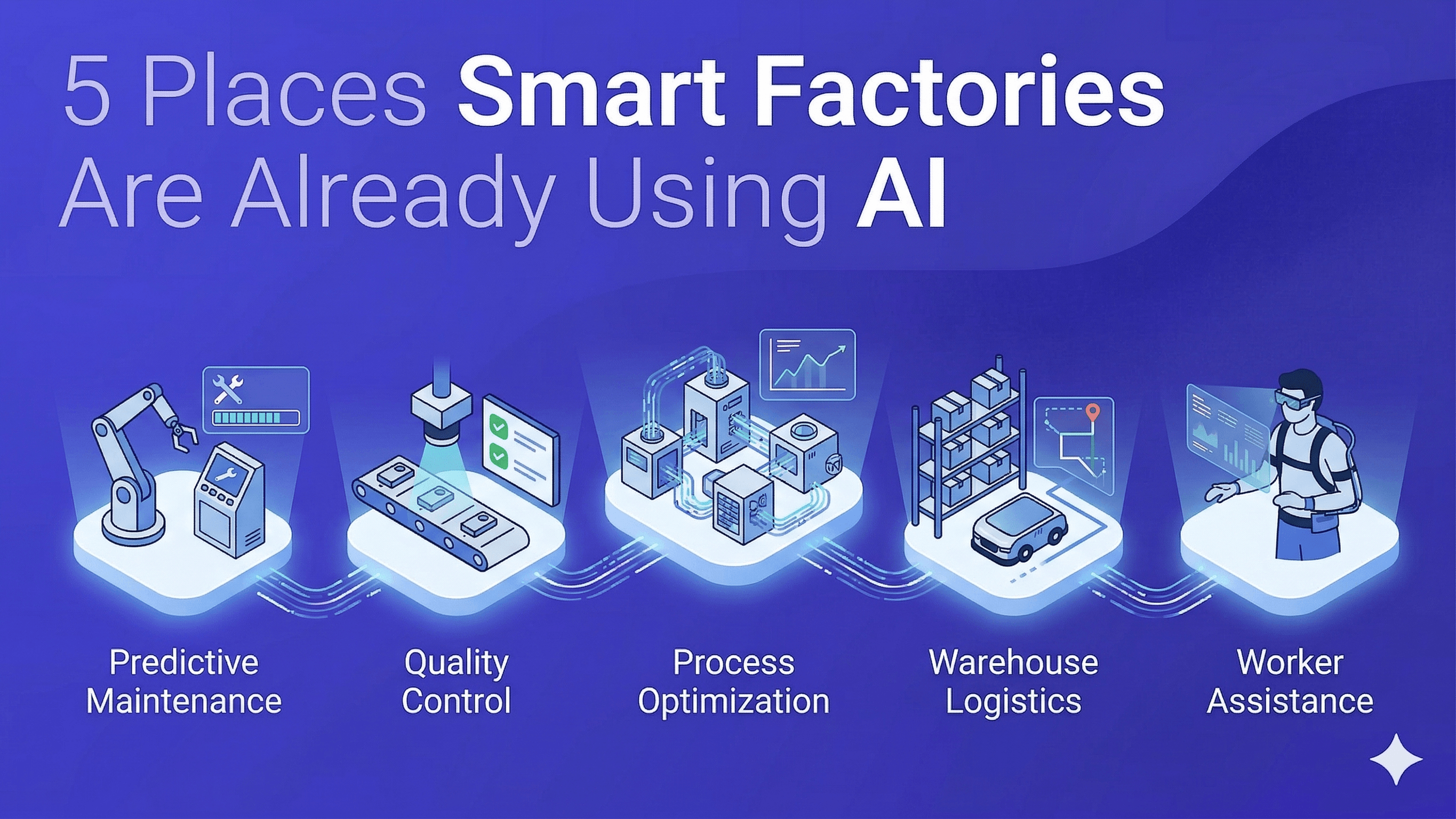
The factory floor wasn't exactly an early adopter of artificial intelligence.
It's a world built around physical processes: tolerances, throughput, shift schedules. The automation that arrived decades ago was powerful but rigid. Machines that did exactly what you programmed them to do, nothing more.
That's changed.
AI is now embedded in manufacturing operations in ways that are easy to miss. Not in the headline-grabbing robots, but in the systems quietly running underneath: predicting failures, catching defects, optimizing energy loads, and compressing deployment timelines.
The question isn't whether AI has reached the factory floor. It has. The question is where it's actually doing useful work.
Here are five answers.
Predictive Maintenance on CNC Machines
Manufacturers lose $50 billion a year to unplanned downtime. Here's what that actually looks like: a CNC machine goes down at 2am, the part isn't in stock, the order misses its window, and the schedule takes three days to recover.
The problem was never detection. Factories have had sensors for decades. It was interpretation. A temperature spike means nothing without knowing what's normal for that machine, on that material, at that feed rate. Threshold-based alarms can't know that. A model trained on months of operational data from that specific machine can.
Predictive maintenance learns the baseline and watches for drift. Bearing wear shows up as a frequency shift in vibration data. Spindle imbalance leaves a signature in motor current. None of these are visible on the floor, but all of them are readable in the data, 24 to 72 hours before failure.
Harley-Davidson has been running vibration-based predictive maintenance on plant equipment for longer than most manufacturers realize. But you don't need that scale. We built an AI vibration anomaly detector for industrial motors using an autoencoder trained on healthy vibration data, running inference directly in Node-RED. The model learns what normal looks like. When that changes, you get a warning with time to act.
That's the shift. Not better alarms, but a system that knows the difference between a machine running hard and a machine running out of time.
Visual Quality Inspection
Manual inspection has a hard ceiling. Put someone at a line running 200 units a minute for four hours and their defect detection rate drops. That's not a training problem. It's physiology.
Computer vision doesn't have that ceiling. A camera at the inspection station sees every unit, not a sample, at full line speed, catching surface defects, dimensional drift, solder bridges, and weld inconsistencies. In semiconductor fabrication, where a particle smaller than a human hair destroys yield, vision-based inspection isn't an upgrade. It's the only option that makes sense at volume.
BMW's AIQX platform runs camera and sensor-based AI quality checks across every plant globally. At Spartanburg, it monitors roughly half a million weld studs daily. At Regensburg, the GenAI4Q system generates a custom inspection checklist for each of 1,400 vehicles built daily, adapting to every model variant in real time.
There's a compounding effect worth noting: every defect caught becomes labeled training data. The model improves continuously. The longer it runs, the harder it is to beat.
Human inspectors still matter for root cause and edge cases. But the first pass, the one that runs on every unit at line speed, is not a job for human eyes anymore.
Shorter Path from Pilot to Production
Manufacturers consistently underestimate integration time. The technology decisions get made, the use case is clear, and then the project stalls for months. The pilot ran on clean exported data. Production means live data from PLCs running proprietary protocols, historians not designed for real-time access, and network segments that exist for good reasons. Most IIoT initiatives don't fail at the algorithm layer. They fail at the plumbing.
That gap is expensive. A deployment that takes six months to reach production has a very different ROI profile than one that takes six weeks. And it's precisely here that AI is changing the economics of development. Engineers are generating integration flows from plain language descriptions, tracing protocol mismatches that would have previously burned days, and producing documentation as they build rather than long after. The unglamorous middle work moves faster.
FlowFuse Expert is built for exactly this. AI assistance embedded directly in the Node-RED editor: inline code completions as you write, next-node predictions as you build, and a chat interface that understands your actual flows and live debug output. Describe the logic you need and it writes the function node. Something behaving unexpectedly? Load your flow and debug logs as context and work through it together. Fewer hours lost to problems that have already been solved a hundred times before.
Energy and HVAC Optimization
Most smart factory conversations never get to the building itself. That's a mistake.
HVAC is one of the largest energy costs in a manufacturing facility and one of the least optimized. A factory's thermal load shifts constantly: which lines are running, what materials are being processed, outdoor temperature, occupancy. Rule-based systems deal with that complexity by setting conservative margins everywhere and leaving them there. It works, but you pay for it on every energy bill.
AI learns the actual behavior of the facility and stops defending against conditions that aren't happening. Yokogawa deployed reinforcement learning for HVAC in its semiconductor plant in Japan. In that facility, cleanroom HVAC accounted for roughly 30 percent of total energy consumption, a figure consistent with, though on the lower end of, what's reported across the semiconductor industry. The result was a 3.6 percent reduction in total consumption. Modest on paper, significant at scale, and it improves as the model keeps learning.
DeepMind's data center work gets more attention, but that's a controlled, single-purpose environment. A factory is harder. Yokogawa is the more relevant proof of concept.
Worker Safety and Ergonomics Monitoring
Musculoskeletal disorders are the most common workplace injury in manufacturing. A bad lift, an awkward reach, a sustained bent posture on a repetitive task: the injury doesn't happen dramatically. It accumulates over weeks, then shows up as a compensation claim and a gap on the line.
Traditional ergonomics assessment catches this late. A consultant observes a workstation, writes a report, and by the time recommendations are implemented, workers have been loading their joints wrong for months.
Pose-estimation AI runs overhead cameras continuously and scores every movement in real time against established ergonomic risk frameworks, flagging a bend angle that will cause a back injury long before it materializes. In one manufacturing pilot study, researchers reported roughly a 25 percent reduction in workplace injuries, with posture compliance improving once workers received real-time feedback. Results will vary by facility, workstation type, and baseline injury rates.
The privacy question deserves a direct answer: these systems track skeletal keypoints, not faces or identities. What gets logged is joint angle data, not footage of individuals.
What makes this different from a safety poster is that it doesn't rely on the worker remembering. The system watches every repetition, on every shift.
Where to Start
The five use cases covered here aren't experiments. They're running in production facilities today, on real lines, delivering measurable results. The gap between manufacturers who've deployed AI and those still evaluating it is growing, and it compounds.
But starting doesn't require a complete digital transformation. Pick one problem that's costing you money right now: unplanned downtime on a critical machine, a defect rate you can't get below, an energy bill that doesn't reflect how efficiently you actually run. That's your first use case.
The common thread across all five use cases is the same bottleneck: getting operational data to a model reliably and acting on what it returns. That's the integration problem most deployments stall on. FlowFuse is built around solving exactly that. You connect to your PLCs, deploy your AI model, and trigger actions all within the same flow, which is why it's where most manufacturers start and where they keep building.
The manufacturers seeing results didn't wait for the perfect conditions. They started with one line, proved the value, and expanded. That's still the fastest route from where you are to where you want to be.
Start With One Use Case. Build From There.
Whether it's predictive maintenance, quality inspection, or energy optimization, FlowFuse connects your OT data to AI models without a multi-year transformation.
About the Author
Sumit Shinde
Technical Writer
Sumit Shinde is a Technical Writer at FlowFuse specializing in industrial automation and manufacturing. In the past three years, he has built industrial applications and authored more than 100 technical articles covering industrial connectivity, unified data architecture, production metrics, and quality management for modern manufacturing.
Like what you're reading?
Add FlowFuse as a preferred sourceOn the page that opens, check the box next to flowfuse.com to see more of our articles in your Google Search results.